The Portfolio Paycheck: Moving Beyond the Growth Trap
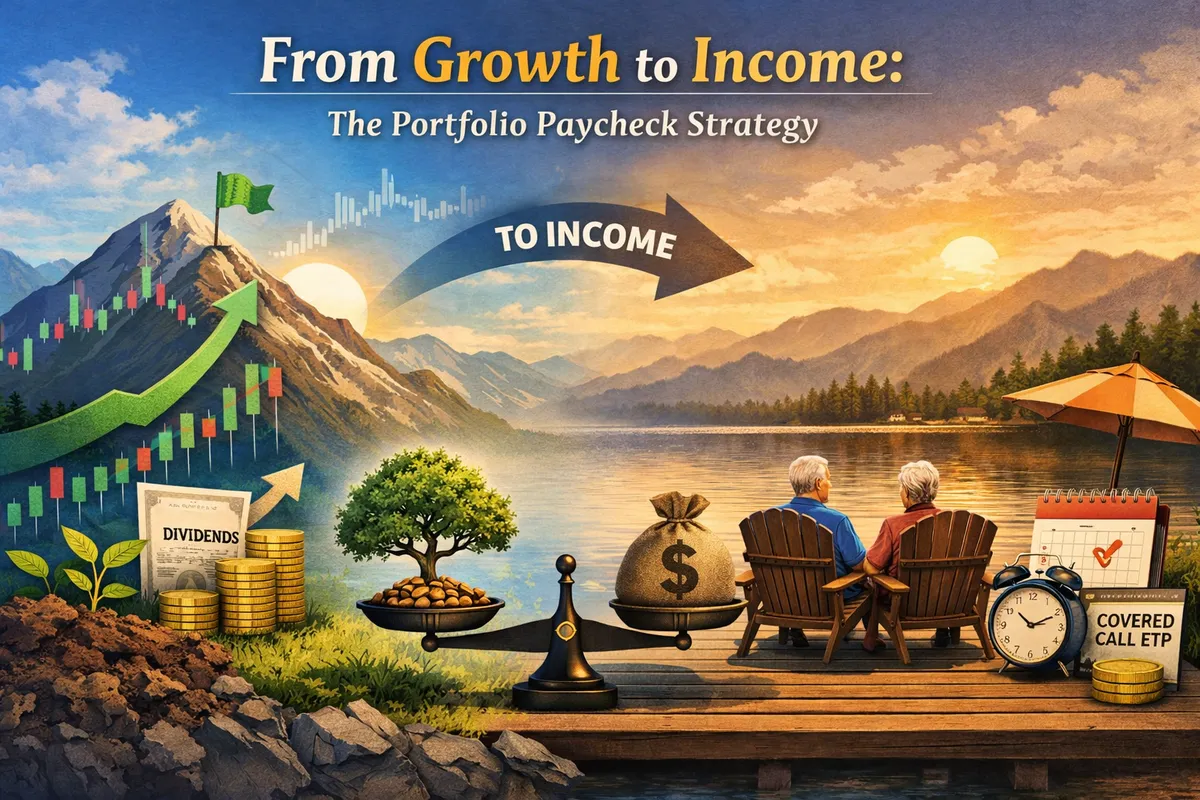
1. The Net Worth Paradox
You're staring at a seven-figure balance on your screen, but you're still checking the price of eggs at the grocery store. That is the Net Worth Paradox.
For years, you've followed the script: buy index funds, watch the market climb, and celebrate every new milestone. But despite the "number" going up, your daily life doesn't feel any richer. Your wealth is trapped behind a glass wall.
This happens because most investors are experts at accumulation but have no idea how to actually use what they've built. Their portfolio functions like an "unpaid intern" — it shows immense future potential and looks great on a resume, but it provides absolutely nothing to live on today.
The purpose of this post is to show you how to bridge that gap. We're moving from the "accumulation" phase to creating a reliable, monthly "paycheck" that gives you actual financial peace of mind.
2. The "Unpaid Intern" Problem: Growth is Not Income
Growth investing is the standard game. You buy quality assets like VOO or QQQ, tech-heavy stocks, or broad market index funds and let them compound. It is highly effective for building a large "number," but it fails the "lifestyle" test.
A growth portfolio pays like an unpaid intern because its value is tied up in "exposure" and "future potential." It promises wealth tomorrow while leaving you cash-poor today. To get a single dollar out of it, you have to sell a piece of the engine.
Most investors get "stuck" in this phase. They've spent decades focused on the size of the pile, only to realize they lack a strategy to turn that pile into spendable cash without destroying their principal. They are wealthy on paper, but they are still working for their money instead of the other way around.
3. Sequence of Returns: The Silent Killer of Retirement
If your only way to generate cash is by selling shares, you are a prisoner to market timing. This is where things get dangerous.
When the market drops 20% but you still have a mortgage to pay and groceries to buy, you are forced to sell your shares at the worst possible time. This isn't just a "dip" anymore; it's a permanent loss of capital. Those shares are gone forever and can never participate in the eventual recovery.
Welcome to sequence of returns risk — the silent killer of retirement plans.
By relying solely on selling growth assets, you turn a temporary market fluctuation into a permanent destruction of your retirement floor. That is not a strategy; it's a gamble.
4. The Mindset Flip: From "What It's Worth" to "What It Pays"
To move from Phase 1 (Accumulation) to Phase 3 (Income), you have to survive Phase 2: The Transition. This is where most people "wing it" and fail.
The transition requires a massive psychological shift. You have to stop asking the question that dominated your life for thirty years: "How much is my portfolio worth?"
Instead, you must start asking: "How much does it pay me every month?"
When you prioritize cash flow over price swings, market volatility loses its teeth. You stop obsessing over whether the S&P 500 is up or down 2% today because your lifestyle is supported by the income the assets generate, not the price at which they currently trade. This shift is the foundation of true financial peace of mind.
5. The "No-Regret" Rotation Strategy
You don't just flip a switch from growth to income overnight. Doing so is the fastest way to trigger a massive, unnecessary tax bill on your capital gains or mistime the market entirely. Instead, use a "no-regret" rotation plan:
Step 1: Redirecting New Money
This is your "no-impact" move. Stop reinvesting dividends into growth and start directing all new capital into income-producing assets. You're building the income layer without touching your core. Use the ETF Screener to filter by distribution frequency and yield to find income-focused ETFs that fit your criteria.
Step 2: Slow Rebalancing
This is a "low-impact" shift. Move 5–15% of your portfolio annually. This strategic trimming of gains allows for a tax-efficient transition and smooths out timing risks.
Step 3: Building a Hybrid Portfolio
You aren't abandoning growth; you're balancing it. Aim for a 50–70% growth split to provide "inflation protection" (keeping your buying power alive) and a 30–50% income split to serve as your "cash flow engine."
This gradual approach ensures you never regret "getting out" too early or "getting in" too late. Once you've identified your target mix, build a portfolio in Portfolio Vision to see exactly how the growth and income sides work together before committing real dollars.
6. The Yield Trap: Why "Highest" Isn't Always "Best"
When you start looking for income, you'll see monthly and weekly income ETFs, blue-chip dividend stocks, and covered call ETFs. The temptation is to find the highest percentage and click "buy."
This is the "Yield Trap." The biggest mistake you can make is chasing yield blindly. High yields are often unsustainable; when they inevitably cut their payouts, your financial security is disrupted. You have to understand the trade-offs: yield vs. growth, and stability vs. variability.
A professional income portfolio must be:
- Diversified: Spreading risk across different asset classes and strategies.
- Structured: Specifically organized to meet your monthly cash needs.
- Predictable: Providing reliable payouts regardless of what the headlines say.
Use the ETF Comparator to stack candidates side by side — compare distribution yield, expense ratio, and NAV erosion before making your pick.
7. Moving From Guesswork to Projections
Most investors with a $500,000 portfolio are just guessing. They don't know if that half-million will pay them $1,000 or $5,000 a month. They don't know how stable that check will be when the market turns red.
This "investor's anxiety" comes from a lack of data. To gain real peace of mind, you need to move beyond guesswork.
This is where Dividend Vision's Portfolio Analysis becomes essential. Instead of "hoping" for the best, you can map out actual numbers. Drop your holdings into the dashboard, and the income forecast will show you projected monthly payouts, distribution calendars, and yield-on-cost trends. You can see exactly how a specific trade or a strategy shift will affect your monthly paycheck before you execute it. It turns your portfolio from a vague concept into a structured, professional paycheck.
8. The Final Question
The end state of this journey is a portfolio that works as hard for you as you once worked for it. You no longer watch the market daily because your income is decoupled from share price volatility. You have moved from chasing a number to designing a life.
Growth builds wealth, but income is what allows you to live off it. Every investor eventually reaches a crossroads where the old metrics no longer apply.
"At some point, the question stops being 'How big can this get?' and becomes 'How much can this pay me?' — are you ready for that shift?"
Keep Exploring
- Portfolio Vision — Build a portfolio and see projected monthly income instantly
- ETF Screener — Filter income ETFs by yield, frequency, and strategy
- ETF Comparator — Compare funds side by side before rotating
- SEC Yield vs. Distribution Yield — Know which yield number actually matters
- Dividend Aristocrats: 6 Surprising Truths — Income stocks that have paid and raised for 25+ years
- $1,000/Month Income Portfolios — Pre-built templates to hit your first income milestone