If Hackers Strike Tomorrow, What’s in Your Portfolio and Your Costco Cart?
From cybersecurity ETFs to backup generators, follow the money businesses and households spend getting ready for the lights to go out.
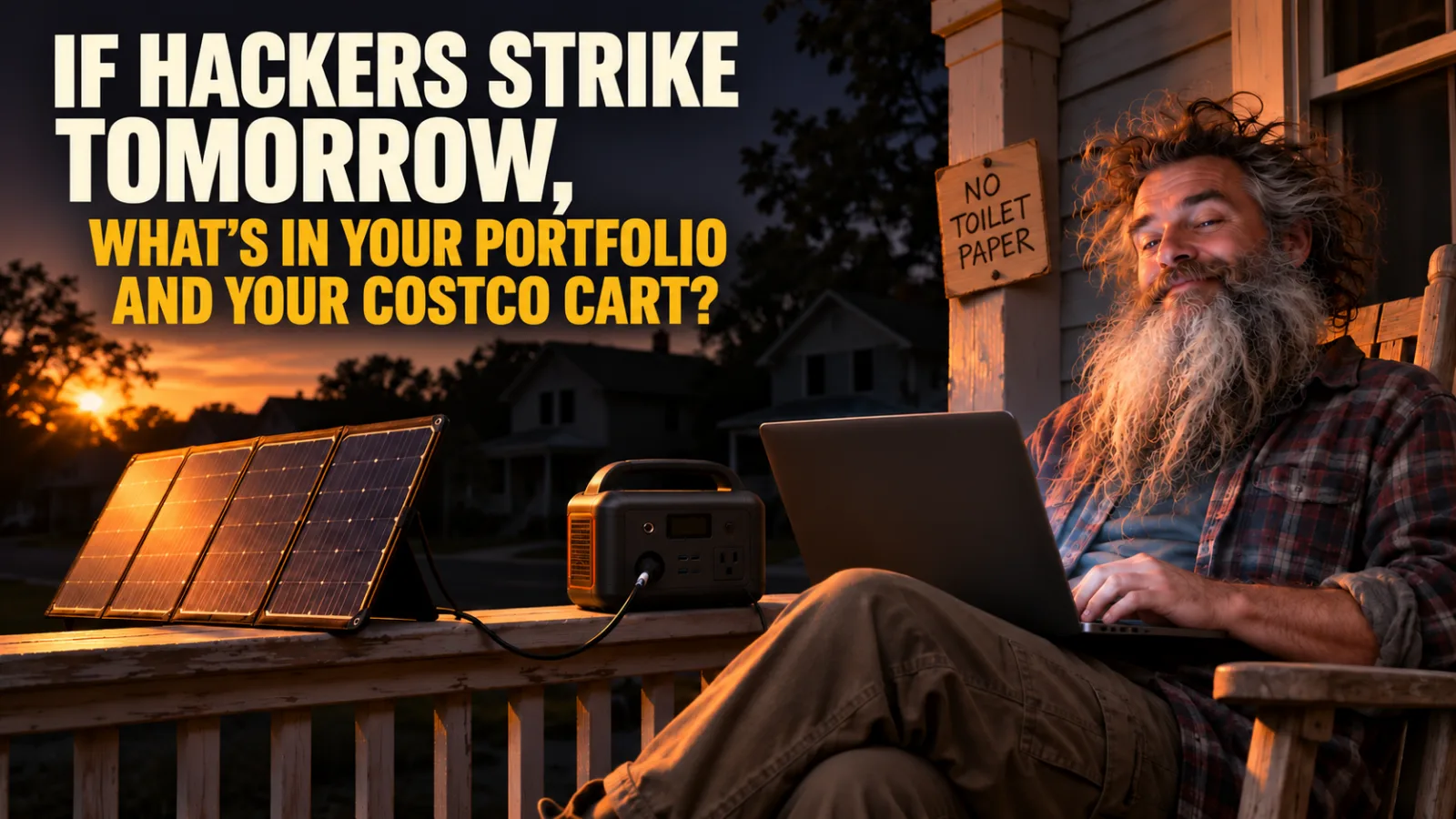
The guy with the solar-powered laptop and the “NO TOILET PAPER” sign has a plan for the apocalypse. He bought the hardware. Somewhere else, a security chief is deciding whether to renew a software contract. Both are spending money on a backup plan. For an income investor, the question is who collects that money and how much can reach shareholders.
Part one · Who gets paid to secure a network?
In September 2025, Anthropic detected an espionage campaign aimed at roughly 30 organizations. The company reported a handful of successful intrusions and estimated that AI performed 80% to 90% of the tactical work. Humans chose the targets and made key decisions. A year later, Anthropic documented further cases in which small groups used AI to sustain campaigns that once would have taken larger teams. 2025 investigation · 2026 follow-up
Nvidia’s Brev cloud platform offers a concrete example. After a 2026 incident, Nvidia replaced access keys that might have been exposed and said it had found no evidence of misuse. For a customer, the immediate job was restoring confidence in access to its machines. For a shareholder, the question is which vendor earns the next contract to protect them. Reporting on Nvidia’s customer notice
For investors, there are several steps between an alarming headline and a dividend. A customer has to buy a security product. The vendor has to win that contract at a profit. Then management decides whether to pay shareholders, buy back stock or hire engineers. A cybersecurity ETF gives you exposure to those decisions. One fund adds a way to collect cash while you wait, with a trade-off when the sector rallies.
Three ways to own the companies
CIBR, the First Trust Nasdaq Cybersecurity ETF, tracks the Nasdaq CTA Cybersecurity Index. HACK, the Amplify Cybersecurity ETF, follows the Nasdaq ISE Cyber Security Select Index, covering hardware, software and services. BUG, the Global X Cybersecurity ETF, follows the Indxx Cybersecurity Index. If you already own a technology fund, compare each fund’s largest positions and weights against your holdings. Buying a second ticker can simply give a company you already own a bigger vote in your portfolio. CIBR · HACK · BUG
Try the cybersecurity ETF screener
Open the cybersecurity ETF screener on Dividend Vision. The link opens with ETFs selected and the Cybersecurity tag applied.
Find HACK and HAKY in the screener. Read across to Expense Ratio, Dist. Freq. and Dist. Rate. HACK tracks an index. HAKY sells calls and pays monthly. The distribution rate measures cash paid relative to the share price. How did those payouts and the change in share price add up?
Open HACK and HAKY in Dividend Vision Compare. Under Growth of investment, choose 6M and Fund Total Return, with reinvestment at 100%. Both lines start at zero on the same date. Switch to Price to see how the picture changes when you leave out distributions.
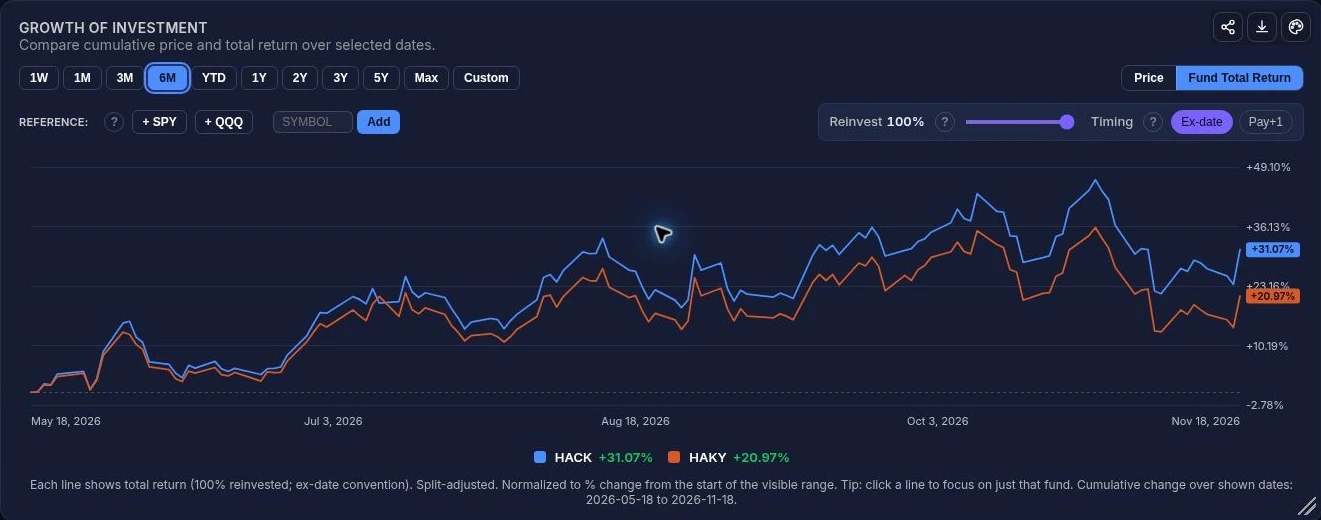
Same dates, same reinvestment setting. From May 18 to November 18, 2026, HACK returned 31.07% and HAKY returned 20.97%, including reinvested distributions.
For a fee comparison across three index funds, find CIBR, HACK and BUG. The chart below translates their expense ratios into dollars on a $10,000 investment.
| BUG (0.50%) | 50USD |
|---|---|
| CIBR (0.58%) | 58USD |
| HACK (0.60%) | 60USD |
| HAKY (0.65%) | 65USD |
Illustration using a constant $10,000 balance and expense ratios of 0.50%, 0.58%, 0.60% and 0.65%. Expenses accrue within the funds.
The biggest fee gap here is $15 a year per $10,000. The decision to sell calls can matter much more than that. HACK and HAKY make a particularly useful pair for seeing why.
How HAKY turns some potential upside into cash
The Amplify HACK Cybersecurity Covered Call ETF, HAKY, launched in January 2026. Its strategy combines cybersecurity exposure with selling call options. Option buyers pay a premium for the opportunity to benefit from gains above a specified price. When stocks surge, part of the gain on the covered exposure goes to those buyers. When stocks fall, the premium provides only a limited cushion. HAKY fund details
What a covered call changes in dollars
Start with a hypothetical $100 share. Suppose an investor buys 100 shares and sells one call contract covering those shares at a $105 strike. The premium is $3 per share. Here is the profit or loss per share at expiration.
| Share ends at | Share alone | Share + call sold |
|---|---|---|
| $85 | −$15 | −$12 |
| $100 | $0 | +$3 |
| $120 | +$20 | +$8 |
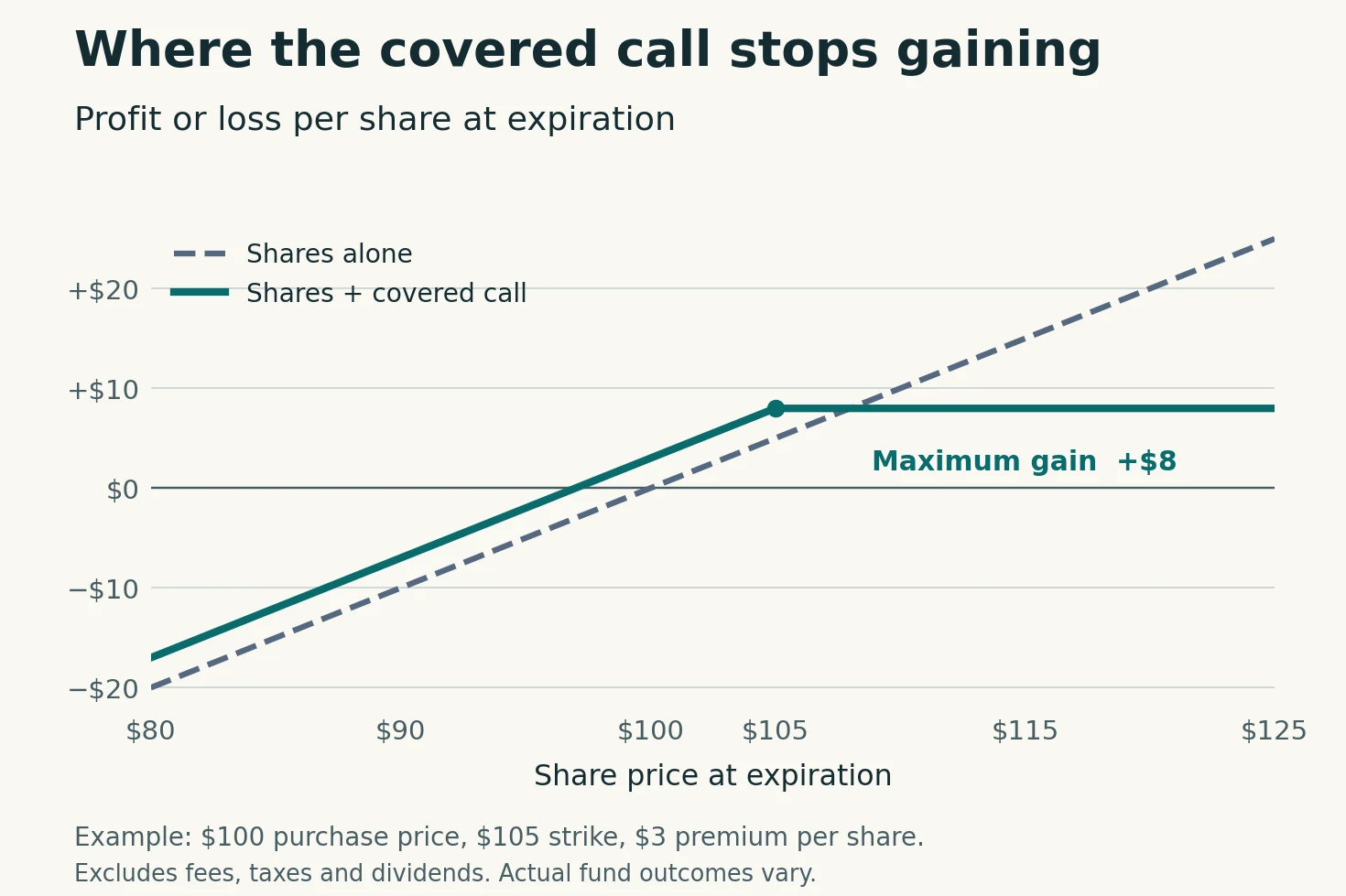
The $3 premium lowers the break-even price to $97. Above the $105 strike, the covered position earns a maximum of $8 per share. · Source: Dividend Vision illustration using the Options Industry Council covered-call formula.
Covered-call mechanics from the Options Industry Council
Illustrative profit or loss per share before fees, taxes and dividends. HAKY’s actual coverage, premiums and results vary.
What does a monthly payout actually tell you?
On August 31, 2026, Amplify showed a 15.19% annualized distribution rate for HAKY alongside a −0.14% 30-day SEC yield. Those numbers answer different questions. The first annualized the current payout relative to net asset value. The second measured recent investment income after expenses and excluded option income. Amplify says distributions may include return of capital. Neither figure tells you what shareholders earned over a year. Issuer figures and definitions
To judge the trade, compare HAKY with HACK from the same start date. First look at total return with payouts reinvested. Then look at the cash an equal investment actually distributed and the value of the shares left at the end. If you spend your distributions, that second view tells you how much cash reached your checking account and how much capital is still working.
There is also a corporate dividend route. Gen Digital (GEN), the company behind Norton, Avast and LifeLock, declared a quarterly cash dividend of $0.125 per share payable December 9, 2026. The board declares that payment from the business. HAKY’s distribution has a different source and can include option proceeds and return of capital. Gen Digital quarterly results
For someone who wants exposure to rising cybersecurity profits, holdings and concentration come first. For someone who wants monthly cash, HAKY adds a specific decision: how much upside are you willing to exchange for that payment? That question will still matter after the next cyberattack drops off the front page.
Part two · When households stock up, who makes the sale?
The guy on the porch has a solar panel. His neighbor has a simpler backup plan: a Costco run before the freezer thaws. Either one might be thinking about a cyberattack, a winter storm, or the last time the lights went out. Their receipts tell us which businesses made a sale. The next earnings report tells us whether those purchases added up.
The Costco cart and the companies behind it
Costco (COST) sells a ReadyWise bucket with 150 servings of emergency food. In November 2026, a Mizuho analyst following Costco also observed that high-priced generators had sold out online. Those are two very different purchases on the same warehouse receipt. For a Costco shareholder, the question is whether shoppers spent extra or simply bought next month’s groceries early. Comparable sales and membership renewals offer a better test than a photo of an empty shelf. Costco’s ReadyWise listing · CBS MoneyWatch reporting · Costco annual filing
Tractor Supply (TSCO) sees a different shopping cart. The retailer reported stronger year-over-year demand for generators, propane and tanks. One customer might need all three to keep a rural property running. For investors, the useful comparison is whether that extra spending lifts sales across stores and how much gross profit the retailer keeps on the merchandise. Retailer comments
On the food-maker side, Bridgford Foods (BRID) makes shelf-stable sandwiches originally developed to meet a military requirement. It also sells frozen dough and meat snacks, so buying BRID gives an investor exposure to several food businesses. ReadyWise is the brand on the Costco bucket. Bridgford is a separate example of a publicly traded producer. Bridgford’s ready-to-eat business · Company filing
Backup power has a sales cycle
Generac (GNRC) shows what a run on generators can mean for a manufacturer. Residential product sales climbed from $2.06 billion in 2023 to $2.43 billion in 2024. Generac linked stronger U.S. standby and portable generator demand to outages in the second half of 2024. In 2025, outages were less frequent and residential sales fell to $2.27 billion. A family that installed a standby generator last summer can use it through the next outage without buying another one.
| 2023 | 2063 |
|---|---|
| 2024 | 2433 |
| 2025 | 2267 |
Generac 2024 annual filing · Generac 2025 annual filing
Energizer (ENR) supplies a smaller purchase: the batteries for a flashlight or portable radio. In its fiscal 2026 results, Energizer said stronger storm demand the year before contributed to a tougher sales comparison. Someone who brings home a spare pack of AAs may already have enough for the next storm, too. Energizer fiscal 2026 results
Tents, camp stoves and fishing gear
Sportsman’s Warehouse (SPWH) is a public retailer for tents, camp cooking equipment, rods and tackle. Bass Pro Shops, which owns Cabela’s, is privately held. If those are the stores that come to mind when you picture the shopping trip, SPWH gives you a public company whose department sales you can actually inspect. Sportsman’s Warehouse quarterly filing · Bass Pro ownership · Cabela’s acquisition
Camping and fishing together brought in almost 31 cents of every sales dollar in the quarter ended August 1, 2026, before the November outages. That total includes both the family buying a tent for vacation and the household buying one for backup shelter. The filing gives us a sales mix. It can’t tell us what sent each shopper to the store.
A cybersecurity vendor can earn a renewal next year. Costco can earn another membership fee. Generac generally has to find another household to sell a new standby unit. All three can make a sale when someone wants a backup plan, but an income investor has one more question to ask: which of those purchases is likely to repeat and leave cash available for shareholders?