Beta, Sharpe, and Sortino: The Three Risk Numbers Every Income Investor Should Know
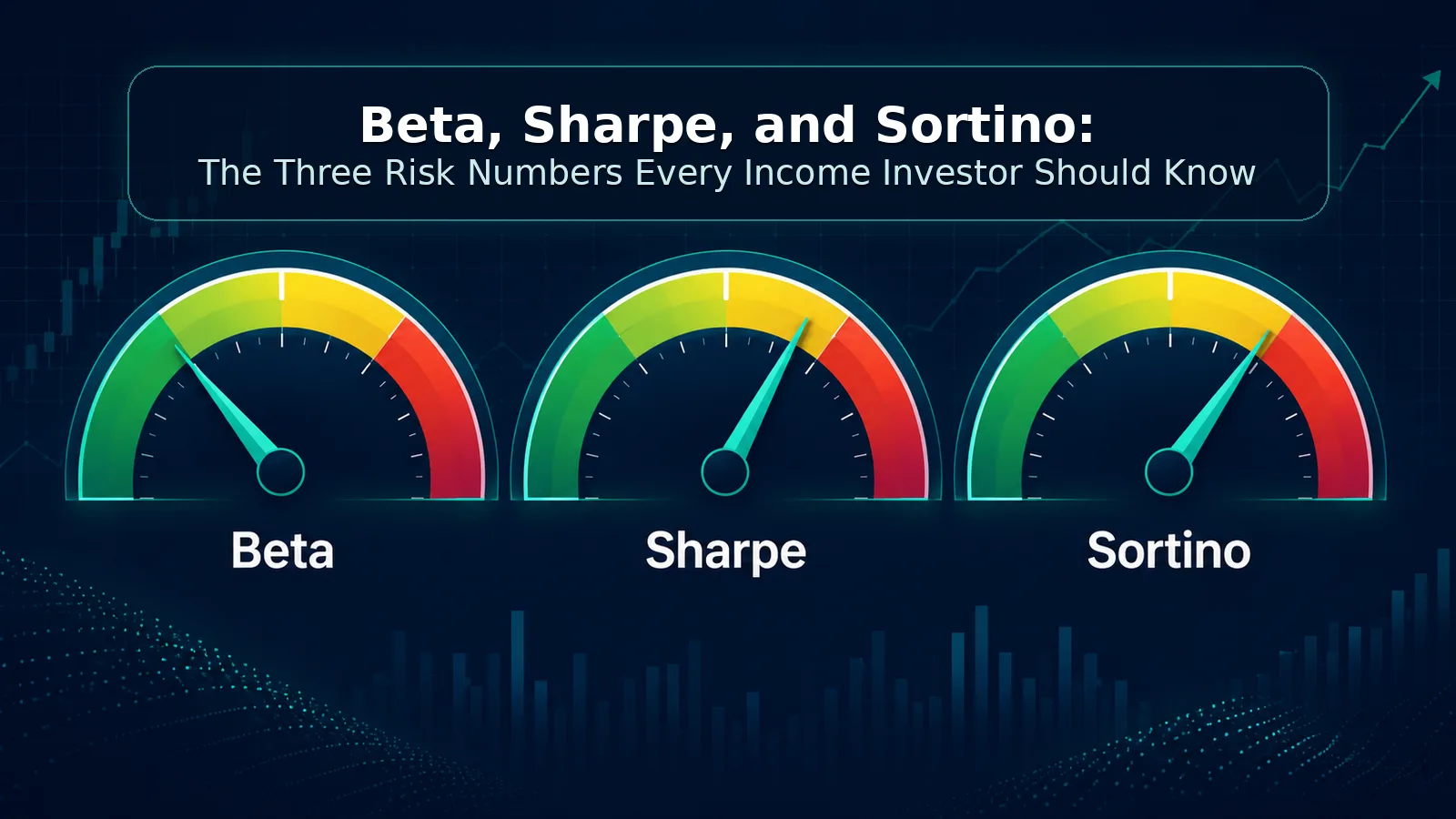
Yield tells you what a portfolio pays — Beta, Sharpe, and Sortino tell you what it costs you in risk. What each metric means, what counts as a good score, how to improve yours, and where to find all three on your Dividend Vision dashboard.
Beta: how hard does the market yank your portfolio around?
Beta measures how much your portfolio moves relative to the overall market (think S&P 500).
- Beta = 1.0 — your portfolio tends to move with the market. Market drops 10%, you can expect roughly a 10% drop.
- Beta = 0.5 — about half the market's swings. Market drops 10%, you'd expect roughly 5%.
- Beta = 1.5 — half again as volatile as the market. A 10% market drop could mean 15% for you.
- Beta near 0 — largely indifferent to the market, like T-bill and money-market funds.
Beta only captures systematic risk — the part of your portfolio's movement explained by the market itself. A fund can have a low beta and still be plenty risky for reasons of its own (that's what the Volatility gauge next to it is for).
What's a good Beta?
There is no universally "good" beta — it depends on what you're building. But for income-focused portfolios, lower is usually the goal: you want the paycheck without the white-knuckle ride. The dashboard gauge colors it like this:
| Beta | Zone | Reading |
|---|---|---|
| Below 0.85 | Green | Lower risk than the market |
| 0.85 – 1.5 | Yellow | Market-like |
| Above 1.5 | Red | Notably more volatile than the market |
How to lower your Beta
- Add low-beta sleeves. Cash-like funds (T-bill ETFs, money markets), short-duration bond funds, and defensive sectors (utilities, staples) all pull the weighted average down.
- Trim concentrated high-beta positions. A big slug of leveraged, tech-heavy, or single-stock-linked funds dominates the portfolio number.
- Mind the weights. Portfolio beta is value-weighted — a 2% position in something spicy barely moves it; a 40% position defines it.
One caveat specific to income investing: many option-income ETFs and newer funds don't have a published beta yet (vendors typically need years of history). Dividend Vision computes an in-house gap-fill beta for many of these, but when part of your portfolio still has no usable beta, the dashboard shows a "Partial coverage" note so you know the figure describes the covered slice of your portfolio, not the whole book.
Sharpe ratio: are you getting paid for the risk you take?
The Sharpe ratio answers the single most useful question in portfolio analysis: how much return am I earning per unit of risk?
The formula in plain English:
Sharpe = (your annual return − the risk-free rate) ÷ your annual volatility
The "risk-free rate" is what you could earn doing nothing — parking cash in 3-month Treasury bills. Any return above that is your reward for taking risk; volatility is the price you pay for it. The Sharpe ratio is simply reward divided by price.
Why this matters: a fund returning 12% with wild 30% volatility is arguably a worse deal than one returning 8% with calm 8% volatility. The first has a Sharpe well under 0.3; the second is near 0.5–0.6. Raw return ignores that; Sharpe doesn't.
What's a good Sharpe ratio?
| Sharpe | Zone | Reading |
|---|---|---|
| Below 0.5 | Red | Weak — you're poorly paid for the risk |
| 0.5 – 1.0 | Yellow | Acceptable |
| Above 1.0 | Green | Strong risk-adjusted return |
Sustained Sharpe ratios above 2 are rare outside of unusual market regimes, so don't treat the top of the gauge as a realistic target. Above 1.0 over a multi-year window is genuinely good.
How to improve your Sharpe
You can attack either side of the fraction:
- Raise return without raising volatility — usually by cutting drag: redundant overlapping funds, high-fee products that deliver index-like exposure, or chronic NAV-eroders whose headline yield masks a shrinking principal.
- Cut volatility without giving up much return — diversify across assets that don't move together. Two uncorrelated 8% yielders are less volatile combined than either alone, which raises Sharpe even though the return didn't change.
- Don't over-correct into cash. A portfolio that's mostly T-bills earns the risk-free rate — the numerator goes to zero and Sharpe collapses along with your income.
Sortino ratio: punishing only the downside
Here's the philosophical flaw in the Sharpe ratio: it treats all volatility as bad. A fund that suddenly jumps 6% in a month gets penalized exactly like one that drops 6%. But no investor has ever complained about upside.
The Sortino ratio fixes that. It's the same idea as Sharpe — excess return divided by risk — but the denominator only counts downside deviation: how badly and how often your returns fall short of the risk-free target. Upside surprises don't count against you.
Sortino = (your annual return − the risk-free rate) ÷ your downside deviation
This makes Sortino especially relevant for income investors, because many income strategies have asymmetric return profiles. Covered-call and option-income funds, for example, cap their upside and keep their downside — a profile Sharpe judges more kindly than it deserves and Sortino judges accurately. Conversely, a strategy that limits losses well will score better on Sortino than Sharpe, and that gap is a feature, not a bug: comparing the two tells you what kind of volatility your portfolio has.
What's a good Sortino ratio?
Because the denominator ignores upside, Sortino runs numerically higher than Sharpe — so the bar is higher too:
| Sortino | Zone | Reading |
|---|---|---|
| Below 0.75 | Red | Weak downside-adjusted return |
| 0.75 – 1.5 | Yellow | Acceptable |
| Above 1.5 | Green | Strong downside-adjusted return |
How to improve your Sortino
- Limit losses, specifically. Quality screens, defensive allocations, buffered or collar-style funds, and disciplined position sizing all shrink the downside tail that Sortino measures.
- Avoid blow-up-prone yield. A fund that pays beautifully for 30 months and then drops 40% in one devastates downside deviation. Sortino has a long memory for bad months.
- Diversify income sources. When your payers don't share a single point of failure (one sector, one strategy, one underlying stock), bad months get shallower — and shallow bad months are precisely what Sortino rewards.
How Dividend Vision calculates these
A quick look under the hood, because methodology matters when you compare numbers across sites:
- Beta is sourced per ticker (a multi-year vendor beta against the market, with an in-house regression as gap-fill for newer funds), then value-weighted across your holdings. Holdings with no usable beta are excluded from the average — and flagged with the partial-coverage note when they're a meaningful share of your portfolio.
- Sharpe, Sortino, Volatility, and Max Drawdown come from a backtest of your current holdings: your present basket, at present weights, replayed over up to ~3 years of dividend-adjusted price history using monthly returns. (Max Drawdown is the deepest peak-to-trough drop along that replayed equity curve — the worst stretch you'd have sat through.) The risk-free rate is pulled daily from the live 3-month Treasury yield. One important nuance: this answers "how would my current basket have behaved" — not "how did my account perform," since it doesn't replay your past trades.
That backtest needs at least a year of overlapping history across enough of your holdings, so brand-new funds can leave you with a "Not enough history" note. And if your portfolio simply never had a losing month against the risk-free target over the window, Sortino is undefined — the gauge says "No downside in window" rather than pretending that's a score.
Where to find them on your dashboard
Everything above is live on the Portfolio Dashboard:
- The Risk Metrics widget — semicircular gauge dials for Beta, Sharpe, Sortino, and Max Drawdown (Volatility is one toggle away). The needle shows your value; green/yellow/red bands show the zones from the tables above. Each dial has a ? button explaining exactly what it measures.
- The KPI strip — the same numbers as compact cards if you prefer them to dials: Beta, Sharpe, and Sortino, plus optional Volatility and Max Drawdown cards.
- The gear menu on each widget lets you toggle individual gauges and cards on or off, so your dashboard shows only the metrics you care about.
- The Overview card on your portfolios page shows the Beta, Sharpe, and Sortino dials aggregated across portfolios — same math, same colors, bigger picture.
You can also just ask: the Ask DV chat can read your portfolio's beta and risk metrics and explain them in context.
One final warning: don't chase the gauges
These are diagnostic instruments, not a high score to optimize. All three are backward-looking — they describe the last few years, which may not resemble the next few. A portfolio engineered purely to maximize Sortino over a calm window can still be fragile in a regime it hasn't seen. Use the metrics the way a doctor uses blood pressure: a reading that prompts questions, not a number to game.
And read them in context. A Sharpe or Sortino number compresses a few years of monthly returns into a single figure — it tells you nothing about when or how deep the rough patches were. Pair it with two things: the window it was measured over (ours stretches up to three years of monthly returns, but a basket full of newer funds gets a shorter one — and a shorter window is a noisier number) and the Max Drawdown dial, which shows the worst peak-to-trough fall your basket would have sat through. Two portfolios can post an identical Sharpe and still have completely different worst-case drops — and the drawdown is the one you actually have to live through.
But if you've never looked at yours? Open the dashboard, find the Risk Metrics dials, and see what your yield is actually costing you. The number next to the paycheck is the one that decides whether you get to keep collecting it.
Educational content, not investment advice. Risk metrics are estimates based on historical data and third-party sources, and past behavior does not guarantee future results.