How to Invest in the AI Memory Boom: Stocks, ETFs, and Income Plays
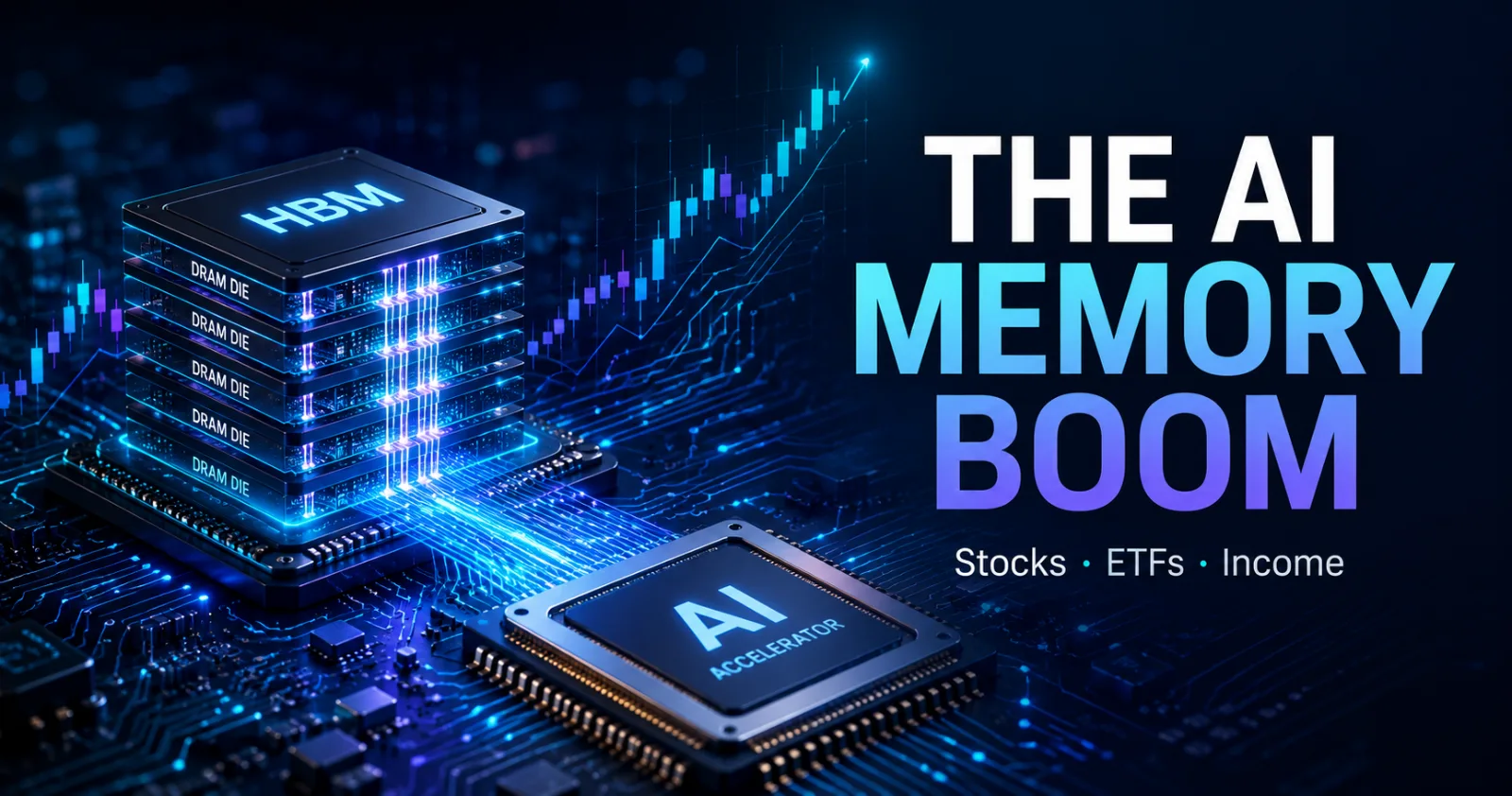
The AI boom runs on memory: here's how to invest in the HBM and DRAM shortage, from chip stocks to the new pure-play and weekly-income ETFs.
For most of the last decade, memory chips were the boring part of semiconductors. DRAM and NAND were commodities — cyclical, low-margin, and prone to brutal price wars. Then AI showed up with a bottomless appetite, and the boring part became the bottleneck.
Every large language model that gets trained, every AI accelerator that ships, every data center that lights up needs an enormous amount of fast memory sitting next to the compute. Nvidia can build the best GPU in the world, but if it can't get enough high-bandwidth memory (HBM) to stack next to it, the chip ships late or not at all. That single fact has flipped the memory market from glut to shortage — and Wall Street has noticed.
This is a guide to the whole menu: the different ways to invest in memory, why the boom is happening, the new ETFs built specifically for it (including ones designed to pay you income), and the risks that come with a trade this hot.
Why the memory boom is happening (it's AI, specifically HBM)
Memory comes in a few types, but two dominate the market you can actually invest in:
- DRAM — the fast "working memory" a processor uses while it computes.
- NAND flash — the slower "storage memory" that holds data when the power is off (SSDs, flash drives). Note that "flash" is the umbrella term; NAND is the high-density type used for storage, while its cousin NOR flash is a smaller niche for code storage.
There's also SRAM — faster than DRAM and needs no constant refresh — but it's expensive and very low-density, so it lives baked onto processor chips as cache (the L1/L2/L3 you see on a CPU spec sheet) rather than being sold as a standalone commodity. That's why DRAM and NAND are the two memory markets traders actually price, and the two an ETF can realistically target.
The category doing the heavy lifting in AI is a specialized form of DRAM called high-bandwidth memory (HBM) — essentially DRAM dies stacked vertically and wired directly into an AI accelerator so data can move at enormous speed. Each new generation of AI chip demands more HBM, faster HBM, and more of the advanced packaging that bonds it all together.
And HBM doesn't stand still — it moves in generations, and each leap is a fresh demand catalyst. HBM3E is the version powering today's flagship AI accelerators; the industry is now moving to HBM4, whose JEDEC standard (JESD270-4) doubles the interface from 1,024 bits to 2,048 bits per stack and roughly doubles bandwidth, while raising per-stack capacity — to feed the next wave of AI chips. Every generation is harder to manufacture, commands a higher price, and consumes more wafer capacity than the last — so the upgrade cycle itself keeps tightening supply even when raw chip counts hold steady. For the three companies that can actually produce it at scale, that's a recurring step-up in revenue rather than a one-time pop.
Three things make this more than a passing spike:
- AI servers are memory-hungry by design. A single AI training rack can carry many times the memory of a traditional server. As models grow, the memory-per-chip requirement grows with them.
- HBM eats capacity. Making HBM consumes far more wafer capacity than ordinary DRAM, so as manufacturers shift production toward HBM, the legacy DRAM that phones, PCs, and cars rely on gets squeezed too — pushing prices up across the board.
- Only a handful of companies can make it. The pure-play HBM/DRAM world is essentially three giants, which concentrates the profits (and the pricing power) when demand runs hot.
The result: a commodity that used to trade in painful boom-bust cycles is, for now, riding the single largest infrastructure build-out in tech.
The four ways to invest in memory
There's no single "memory stock." The opportunity runs the length of a supply chain, and each layer behaves differently. Think of it as four tiers.
1. The memory makers (the purest exposure)
These companies actually manufacture the chips, so their fortunes track memory prices most directly.
- Micron Technology (MU) — the only US-listed pure-play maker of DRAM, HBM, and NAND. The closest thing to a one-stock bet on the theme.
- Western Digital (WDC) — NAND flash and SSDs.
- Seagate Technology (STX) — hard drives and enterprise storage, the high-capacity tier of the data-center memory stack.
This tier has the most upside when memory prices rise — and the most downside when the cycle turns.
2. The equipment and "picks-and-shovels" makers
You can't build memory fabs without the machines. These names sell into every memory expansion, regardless of which manufacturer wins.
- ASML Holding (ASML) — the lithography monopoly; no advanced chip gets made without it.
- Applied Materials (AMAT) and Lam Research (LRCX) — deposition and etch tools central to DRAM and NAND production.
- KLA Corporation (KLAC) and Onto Innovation (ONTO) — inspection, metrology, and advanced packaging — the steps that make HBM stacking possible.
Equipment names tend to be a slightly smoother ride than the chipmakers, because they sell into capacity growth rather than betting directly on the chip price.
3. The HBM consumers (the demand side)
These companies don't make memory — they buy it by the truckload, and their AI products are the reason the shortage exists.
- NVIDIA (NVDA) — the largest HBM consumer on earth.
- Advanced Micro Devices (AMD) — HBM-powered AI accelerators.
- Broadcom (AVGO), Marvell (MRVL), and Astera Labs (ALAB) — the networking, interconnect, and memory-expansion plumbing that ties memory and compute together inside the data center.
This tier is really an AI-compute bet with a memory tailwind, not a pure memory bet.
4. The ETFs (one ticker, the whole theme)
If picking individual links in the chain isn't your style, this is where most income and thematic investors land — and it's where 2026 got interesting.
The new memory ETFs
Until early 2026, there was no way to buy "memory" in a single ticker. Now there's a small but fast-growing lineup.
Pure-play memory ETFs
Roundhill Memory ETF (DRAM) — the one that started it all. Launched in April 2026 as the first US-listed pure-play memory fund, it holds a tight basket of companies that earn at least half their revenue from memory and storage. It became one of the fastest-growing ETF debuts in history. The trade-off: it's highly concentrated — a handful of memory giants dominate the portfolio.
Tuttle Capital Concentrated Memory Stack ETF (HBMX) — a broader, actively managed take. Instead of pure-play makers only, HBMX reaches across the whole "memory stack" — DRAM, NAND, and HBM producers plus the packaging, testing, and equipment companies behind them — typically 20 to 35 names. A lower revenue threshold lets it own picks-and-shovels suppliers that DRAM screens out.
The quick mental model: DRAM is the concentrated pure-play; HBMX is the diversified supply-chain version. We built a side-by-side breakdown if you want the details: DRAM vs HBMX, or the three-way DRAM vs DRMP vs HBMX.
Getting income from the memory boom
Here's the twist for income investors: memory makers historically pay little or no dividend, and the pure-play growth ETFs above are built for capital appreciation, not yield. A new breed of fund solves that by wrapping the theme in an options-income strategy.
Tuttle Capital Memory Stack Income Blast ETF (DRMP) — takes the same memory thesis and runs a systematic put credit spread strategy on memory-related securities to generate income, distributing weekly. It's how you turn a growth theme into a paycheck — at the cost of capping some upside and taking on options risk.
GraniteShares YieldBOOST MU ETF (MUYY) — a single-name income play that writes options tied to Micron, the purest memory stock, to throw off yield.
These are higher-risk, higher-complexity products. The income is real, but it's manufactured by selling options — which means in a sharp drawdown you keep the premium and the losses.
The broad semiconductor ETFs (memory included, diluted)
If you want memory exposure inside a diversified chip fund rather than a concentrated bet, the established semiconductor ETFs all hold the memory names — just alongside everything else:
- VanEck Semiconductor ETF (SMH)
- iShares Semiconductor ETF (SOXX)
- Invesco Semiconductor ETF (SOXQ)
- SPDR S&P Semiconductor ETF (XSD)
- Invesco Dynamic Semiconductors ETF (PSI)
These give you Micron, Nvidia, and the equipment makers in one low-cost wrapper, but memory is only a slice — you're buying the whole semiconductor industry, not the memory shortage specifically. Compare a pure-play against the broad index here: DRAM vs SMH or DRAM vs SOXX.
The risks nobody mentions at the top
Memory is, historically, one of the most cyclical corners of the entire market. A few things to keep honest about:
- It's still a cycle. Memory has always boomed and busted. Today's shortage is real, but the same capacity expansion that's being cheered now is what creates the next glut. When memory prices roll over, the pure-play makers and the DRAM-style ETFs fall hardest.
- Concentration cuts both ways. A fund where three companies make up the bulk of the portfolio delivers explosive gains and explosive drawdowns. Concentration is the feature and the bug.
- The income funds cap your upside. Options-income ETFs like DRMP and MUYY hand you a yield, but the strategy that generates it gives back some of the rally — and offers limited protection in a crash. The distribution rate is not a free lunch.
- A lot has already happened fast. Some of these funds posted enormous returns within weeks of launching. Chasing a parabolic move is how investors end up buying the top of a cycle.
None of this is a reason to avoid the theme — it's a reason to size it sensibly and know which tier of risk you're actually buying.
How to explore it on Dividend Vision
Every name above is tagged Memory on Dividend Vision, so you can pull the whole landscape in one place:
- Browse the full list on the screener by screening my the "memory" tag — stocks, supply chain, and ETFs together.
- Open any ticker for fundamentals, distribution history, and yield.
- Use the compare tool to put any two or three funds side by side before you commit — DRAM vs HBMX, DRAM vs DRMP vs HBMX, or build your own.
The AI memory boom is one of the clearest demand stories in tech right now. Whether you express it through a pure-play maker, a picks-and-shovels supplier, a diversified ETF, or a weekly-income options fund, the key is matching the vehicle to the amount of risk — and cyclicality — you're actually willing to own.
This article is for educational purposes only and is not investment advice. ETFs that use options strategies carry additional risks; read the fund prospectus before investing.