SpaceX Got the Green Light for 1 Million AI Satellites. That’s 49 Times the Number in Orbit Today.
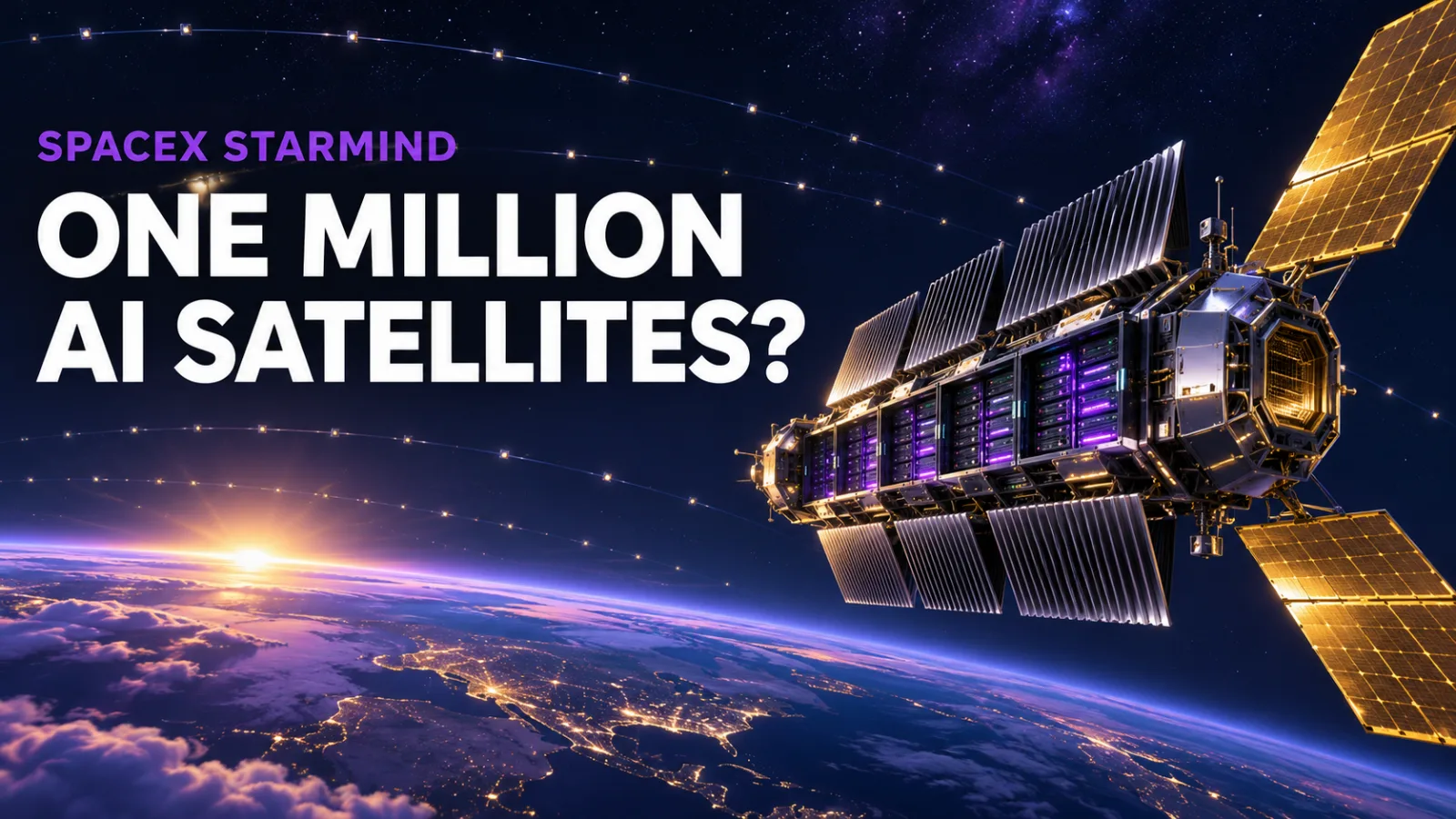
The FCC conditionally cleared up to one million SpaceX AI satellites. Here’s where they could orbit, who’s building competing projects, and what space ETFs actually pay.
There are about 20,500 satellites orbiting Earth. SpaceX just got conditional permission to add up to one million of its own, not to sell internet access like Starlink, but to run AI workloads in space.
CelesTrak’s November 26 count puts the total at 20,457 satellites: 17,501 classified as active and 2,956 inactive. That excludes spent rocket stages and pieces of debris. One million is 49 times the entire satellite count and 57 times the active count. Those comparisons show the scale of the authorization, not what we expect to see in orbit.
Where would the satellites go?
The FCC’s November 25 order puts Starmind in low Earth orbit, 500 to 1,002 km up (about 311 to 623 miles). That’s above the International Space Station’s roughly 400 km orbit. The plan uses bands of altitude about 50 km thick, with some paths tilted 30° to the equator and others in near-polar, sun-synchronous orbits. Those near-polar paths keep a consistent relationship with the sun, which can help with solar power.
One important catch: before deploying satellites that would operate above 600 km, SpaceX must file a license modification with its final orbital-debris plan for those satellites. The FCC deferred the company’s request for alternative disposal methods. The order also limits the licensed backup radio links to tracking and control; the network is intended to move data primarily by laser.
| FCC deadline | Deployment milestone |
|---|---|
| November 2033 | 1 satellite operating |
| November 2035 | 100,000 |
| November 2038 | 500,000 |
| November 2040 | Full authorized constellation |
These are license milestones, not SpaceX launch guidance. One working satellite would show more about what the hardware can do than a million slots on paper.
Who could follow SpaceX?
| Company or project | What’s actually happening |
|---|---|
| Google and Planet Labs | The first Suncatcher prototype launched Oct. 1 on SpaceX’s Transporter-18. Its onboard Google TPU ran Gemma 4 and sent back a haiku. The next test is two interconnected satellites in 2027. Google’s in-orbit results |
| Blue Origin | New Glenn is booked to launch Google’s larger Suncatcher satellites, targeted for Q1 2029, with roughly one data-center rack’s worth of compute apiece. Separately, Blue Origin applied to the FCC for up to 51,600 satellites for its own Project Sunrise. The Google launch deal isn’t regulatory approval for Sunrise. Blue Origin’s Nov. 19 announcement |
| Amazon / AWS | Amazon Leo is a satellite broadband network and buys launch services from Blue Origin, among others. Amazon doesn’t own Blue Origin, and Sunrise isn’t an announced AWS constellation. AWS could be a customer or partner if the economics work, but that’s a possibility, not a disclosed plan. |
| Starcloud | Its first satellite carried an Nvidia H100, and the startup applied for up to 88,000 satellites. That’s a demonstration plus a separate scale-up proposal, not an 88,000-satellite network in service. |
| Meta | Meta’s disclosed AI buildout is on Earth. We found no comparable Meta orbital project. If orbital compute becomes cost-competitive, Meta is easier to picture as a buyer of capacity than as a new constellation operator. That’s our read, not a Meta announcement. |
The first viable business may be smaller than an AI cloud in orbit. For example, an Earth-observation satellite could analyze a large image in orbit and send down the result instead of the whole file. Training a frontier model across many satellites also requires moving large amounts of data between them. Those are two very different tests of whether space makes computing cheaper or faster.
Space ETFs: where does the income actually come from?
SpaceX trades on Nasdaq as SPCX. Its quarterly filing describes launch, connectivity and AI businesses. There’s no separately traded Starmind stock. And the cash paid by a SpaceX-linked income ETF isn’t a dividend from Starmind.
Funds designed to pay cash
| Fund | Strategy | What to watch |
|---|---|---|
| SPCI · Tuttle Space Industry Income Blast | Space-industry basket plus systematic put spreads and other options, with weekly distributions expected but not guaranteed. | You’re taking space-sector risk and options risk. Put spreads can lose money when the market falls. |
| YSPC · YieldMax SPCX Option Income | Seeks weekly income by selling call spreads tied to one stock, SPCX. | Payments vary, downside can outweigh the premium, and a sharp SpaceX rally doesn’t necessarily carry through to the fund in full. |
| XSHP · Kurv SpaceX Enhanced Income | Seeks current income with options tied to SpaceX; Kurv lists it on its monthly distribution schedule. | Different payment schedule, same underlying company risk. Compare the fund’s return after distributions, not just the payments. |
| XVSP · FT Vest SPCX & Target Income | Seeks current income and some price appreciation through SPCX exposure and an options overlay. | Check the issuer’s upside participation figure and actual distributions; a target is not a promised payment. |
What actually landed in investors’ accounts? First Trust’s XVSP paid $0.4126 per share on Sept. 30 and $0.3980 on Oct. 30. Its next declared payment is $0.3856 on Nov. 30. Even with a monthly schedule, the amount can change. First Trust distribution history
YieldMax’s YSPC declared $0.3965 per share, also payable Nov. 30. Its 55.97% distribution rate annualizes that one payment using the Nov. 24 NAV. Its 3.99% 30-day SEC yield measures net investment income through Oct. 31 and excludes option income. Neither figure tells you what you’ll earn over the next year or what the fund’s total return will be. YieldMax’s Nov. 25 announcement
Compare actual payment history, total return with payouts reinvested, and the fund’s NAV trend. Distribution notices can show estimated return of capital; final tax classifications can differ.
Space exposure without making the payout the point
- XSPC · VegaShares Space & AI ETF and NASA · Tema Space Innovators ETF are baskets covering the space economy. Check each fund’s current SpaceX weight; holding both could give you more exposure to the same company than you intended.
- UFO · Procure Space ETF tracks a space industry index. ARKX · ARK Space & Defense Innovation ETF is active and broader, with a defense innovation mandate. Neither is an orbital-data-center pure play.
- LOFF and LOFD aim for +2× and −2× SpaceX’s daily move, respectively, before fees and expenses. Daily resetting makes the result over several days depend on the path the stock takes. These aren’t substitutes for a space basket or an income fund.
Start with Dividend Vision’s ETFs holding SPCX to compare disclosed weights and see which funds use options or leverage.
What I’d watch next
A working satellite. A paying customer. A cost comparison that counts launches, heat rejection, communications and replacement hardware. SpaceX has permission to start finding out whether the idea works at scale. For investors, the first profitable workload matters more than the millionth satellite.
For information only, not investment advice.