6 Surprising Truths About Dividend Aristocrats: The Market’s Most Misunderstood Stocks
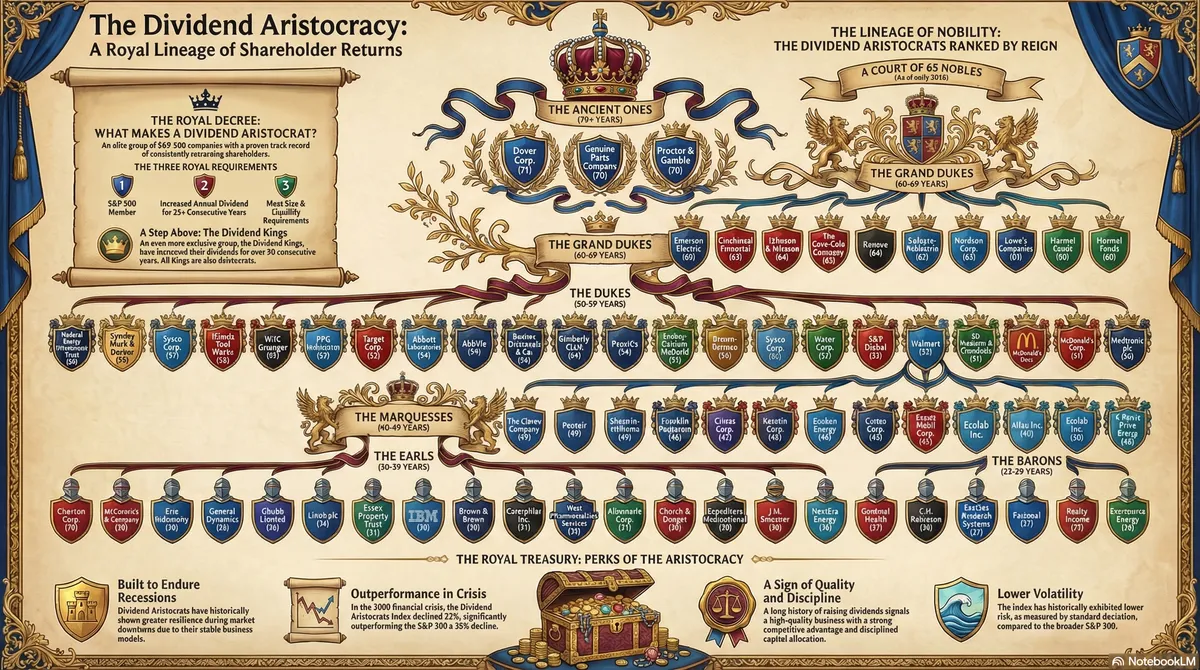
Introduction: The Quiet Engine of Long-Term Wealth
When you think of stock market investing, your mind probably jumps to the frantic, high-stakes chase for the next big thing—a disruptive tech startup or a biotech firm on the verge of a breakthrough. It’s exciting, fast-paced, and often volatile.
But what if a cornerstone of durable, long-term wealth isn’t found in the headlines? Since 1926, dividends have contributed nearly a third of the market’s total equity return, a powerful testament to their importance. At the heart of this story are the Dividend Aristocrats, a quiet class of stocks that most investors think they understand but often overlook. These seemingly “boring” companies hold some of the most surprising and powerful secrets to performance and stability. Let’s pull back the curtain on what makes them tick.
What is a Dividend Aristocrat? (A Quick Refresher)
Before we dive into the surprises, let’s cover the basics. A company earns the prestigious title of Dividend Aristocrat only if it meets a strict set of criteria.
To qualify, a company must:
- Be a member of the S&P 500 index.
- Have increased its dividend for at least 25 consecutive years.
- Meet specific size and liquidity requirements set by S&P.
This simple definition is just the starting point. The real story lies in what these requirements reveal about the underlying businesses.
The Surprising Truths: A Deeper Look
Truth #1: It’s Not About High Yield, It’s About Consistent Growth
The biggest misconception about dividend stocks is that they are all about generating the highest possible immediate income. Many investors chase high-yield stocks, only to be burned when those dividends are cut. (For more on misleading yield numbers, see our deep dive on SEC Yield vs. Distribution Yield.)
The Dividend Aristocrats play a different game. Their average dividend yield is a modest 2.44%. The strategic value isn’t found in the immediate payout, but in the powerful signal sent by its relentless growth. A company simply cannot increase its payout for over a quarter of a century without possessing a strong, durable competitive advantage. This unbroken streak of annual dividend growth is a powerful indicator of exceptional financial health and a management team dedicated to rewarding shareholders year after year.
Truth #2: Their Real Superpower is Defense, Not Offense
During roaring bull markets, the Dividend Aristocrats might not always keep pace with the high-flying growth stocks that dominate the S&P 500. Their real superpower isn’t explosive offense—it’s unshakable defense.
These companies have proven their resilience when markets turn ugly. Consider the historic financial crisis of 2008:
While the S&P 500 plummeted by 38%, the Dividend Aristocrats Index fell by only 22%.
This defensive strength is backed by deeper data. The index has exhibited lower long-term volatility than the S&P 500 (14.33% vs. 15.07%). More precisely, its “downside capture ratio” is 82.4, meaning it has historically captured only about 82% of the S&P 500’s losses in down months. Data also shows the Aristocrats have posted their highest excess returns during periods of high market volatility and falling economic growth, confirming that their true strength is protecting capital when it matters most.
Truth #3: The Club is Deliberately “Uncool”
You won’t find many flashy tech disruptors in the Dividend Aristocrats club. The index is heavily weighted toward traditionally “boring” sectors that form the bedrock of the economy.
Consumer Staples and Industrials together make up over 40% of the index. Meanwhile, the high-growth Information Technology sector, which accounts for over 20% of the S&P 500, makes up only around 3% of the Aristocrats.
This composition is not a bug; it’s a feature. The index is anchored in the real economy, favoring companies that produce essential goods and services over those chasing speculative growth. It’s filled with “old economy” blue chips like Coca-Cola and Johnson & Johnson—companies whose predictable business models allow them to thrive through all economic cycles.
Truth #4: Membership Isn’t Guaranteed—and That’s a Good Thing
The list of Dividend Aristocrats is not a static hall of fame. Companies can, and do, lose their coveted status, reinforcing the rigorous, ongoing standards for inclusion.
The year 2024 provided two stark reminders of this. First, industrial giant 3M was removed from the index, bringing its incredible six-decade dividend growth streak to an end. It was soon followed by Leggett & Platt, which lost its Dividend King status after a 52-year run.
The reasons are a crucial lesson for investors: both companies struggled with bloated expenses, weak growth, and acquisitions that didn’t pan out. 3M also faced billions in losses from product liability lawsuits. This constant curation ensures the title of “Aristocrat” remains a meaningful badge of honor, held only by the highest-quality, most financially disciplined companies.
Truth #5: Some Members Have an Even More Elite, “Royal” Status
If 25 years of dividend growth is impressive, what about 50? For that, there’s an even more exclusive group: the Dividend Kings.
A Dividend King is any company that has increased its dividend for 50 or more consecutive years. This club is the ultramarathon of dividend growth. Interestingly, these companies don’t even need to be members of the S&P 500 to qualify. Currently, there are 57 such companies in existence, representing a truly elite tier of shareholder-friendly businesses.
The list even includes two “unofficial” Kings that highlight the nuances of dividend tracking: Canadian Utilities, whose payout to U.S. investors can fluctuate with exchange rates, and Tootsie Roll Industries, which grows its payout via a consistent 3% stock dividend rather than cash increases.
Truth #6: You Can Be “Born” into Aristocracy
Perhaps the most fascinating quirk of the Dividend Aristocrats is a special rule for corporate spinoffs. When an existing Aristocrat spins off a part of its business into a new, publicly traded company, that new entity can inherit the dividend history of its parent.
This is how a brand-new company can debut on the stock market with decades of dividend growth already under its belt.
- AbbVie is considered a Dividend Aristocrat and a Dividend King because it was spun off from Abbott Laboratories.
- Kenvue, the consumer health company, became a prominent recent example of this rule when it was spun off from Johnson & Johnson in 2023, inheriting its parent’s long dividend history.
This unique rule allows the legacy of dividend discipline to pass from one generation of a company to the next, giving newborn companies an incredible and immediate track record.
Conclusion: The Power of Predictability
The real story of the Dividend Aristocrats isn’t about chasing the highest yields or the latest market trends. It’s about identifying exceptionally durable businesses with a proven, multi- decade commitment to delivering consistent returns to their shareholders. They are a testament to the fact that quality and discipline are timeless virtues in investing.
In a market obsessed with disruption, the Dividend Aristocrats prove that the most powerful strategy is often mastering the art of predictable, profitable, and ever-growing excellence.
Keep Exploring
- ETF Screener — Filter ETFs by dividend history, yield, and sector
- ETF Comparator — Compare Aristocrat-focused ETFs side by side
- Income Goal Calculator — See how much you need to invest to hit your monthly income target
- DRIP Calculator — Model how reinvesting Aristocrat dividends compounds over time
- SEC Yield vs. Distribution Yield — Understand the yield metrics behind these stocks
- Income ETF Launches 2024–2025 — See what's new in the income ETF space