Unlocking the VistaShares Target 15™ ETFs: A Beginner's Guide to the Two-Part Strategy
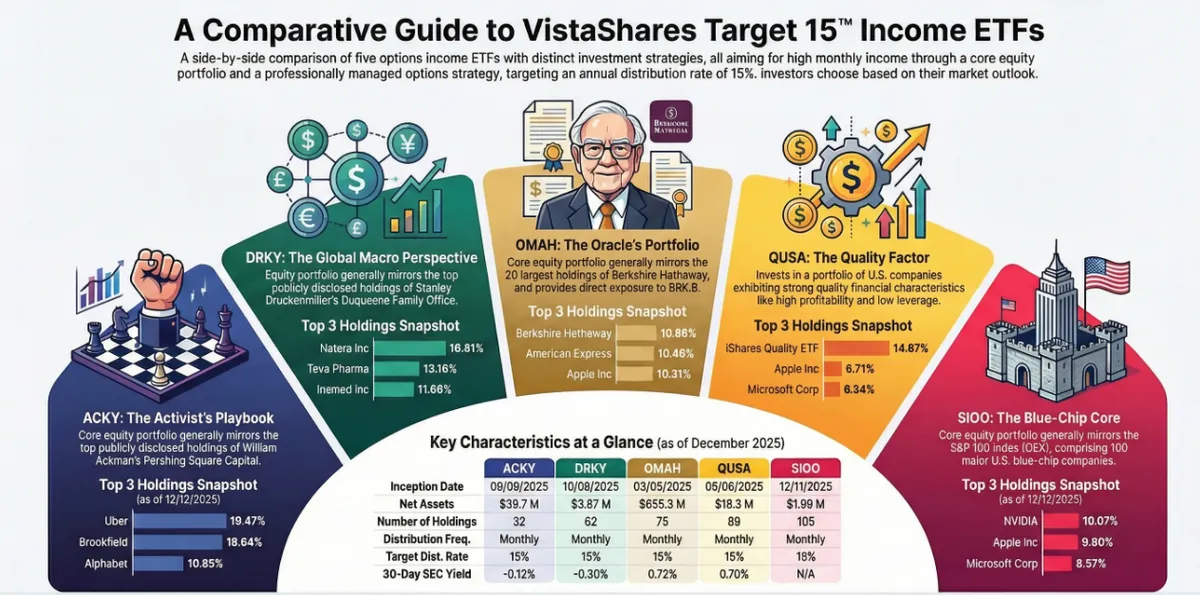
Welcome to the VistaShares Target 15™ family of Exchange-Traded Funds (ETFs). These funds are designed with a specific and ambitious objective in mind. The primary goal of these funds is to seek high monthly income, with an "annual income target of 15%, distributed monthly." To achieve this, they employ a sophisticated two-part investment approach. This guide breaks down those core strategies so new investors can see how they work together.
The two strategies we will explore are:
- Holding a portfolio of stocks for potential growth.
- Using an options strategy to generate regular income.
Strategy 1: The Foundation — The Core Equity Portfolio
The first part of the strategy is the foundation: owning a collection of stocks, also known as an "equity portfolio." This portfolio serves a dual purpose. Its primary purpose is to provide investors with "core equity exposure" to a specific segment of the market. Its secondary goal is to seek "long term capital appreciation," meaning the value of the stocks themselves could grow over time.
Each ETF in the Target 15™ family builds its equity portfolio differently, often by mirroring the holdings of well-known investment firms or major market indexes.
| ETF Ticker | ETF Name | Equity Portfolio is Based On... |
|---|---|---|
| OMAH | VistaShares Target 15™ Berkshire Select Income ETF | Generally mirroring the 20 largest holdings of Berkshire Hathaway and holding BRK.B directly. |
| QUSA | VistaShares QUSA ETF | Generally following the VistaShares QUSA Quality Compounders Portfolio. |
| ACKY | VistaShares Target 15™ ACKtivist Distribution ETF | Generally mirroring the top publicly disclosed holdings of Pershing Square Capital. |
| DRKY | VistaShares Target 15™ DRUKMacro Distribution ETF | Generally mirroring the top publicly disclosed holdings of the Duquesne Family Office. |
| SIOO | VistaShares Target 15™ S&P 100 Distribution ETF | Generally mirroring the S&P 100 Index. |
These different approaches represent distinct investment theses. Choosing OMAH means aligning your investment with the long-term, value-oriented philosophy of Berkshire Hathaway. An ETF like ACKY or DRKY allows you to follow the concentrated, high-conviction ideas of prominent activist and macroeconomic investors. SIOO, in contrast, provides broad exposure to America's largest blue- chip companies.
While this stock portfolio is the essential foundation, a second strategy acts as the primary engine for generating the high monthly income these funds target.
Strategy 2: The Engine — The Options Income Strategy
The second, and more active, part of the approach is the options strategy. This is the primary method used to generate the high monthly income needed to meet the 15% annual target.
In simple terms, the fund's managers implement a "data-driven options investment strategy" on the stocks held in the equity portfolio. The income generated from this strategy comes primarily from what are known as "option premiums." Think of it like selling insurance. The fund's managers collect a payment (the "premium") from another investor. In exchange, they agree to sell their stocks at a certain price in the future. The goal is to consistently collect these premiums as income without having to sell the stocks.
This is a complex process that benefits from "Professional Options Management," meaning it is handled by an experienced team. For a beginner, the most important thing to understand is the purpose of this strategy. The main goal of the options strategy is to generate a regular stream of cash flow for the fund. This cash flow can then be paid out to investors as monthly distributions.
Putting It All Together: A Two-Part Approach
The VistaShares Target 15™ ETFs are built on the synthesis of these two strategies—owning stocks and actively managing an options portfolio.
How It Works
- Own Stocks: The fund begins by investing in a core portfolio of stocks. This provides exposure to the market and creates the potential for long-term growth.
- Generate Income: The fund's managers then generate income by implementing an options strategy on those stock holdings.
- Distribute to You: The income generated from the options strategy, along with any stock dividends or capital gains, is then distributed to shareholders monthly, with the goal of reaching a 15% annual distribution rate.
This two-part approach is reflected in the fund's official objective, which is to "seeks income, and secondarily, long term capital appreciation." This means the fund prioritizes generating cash for monthly payouts over ensuring the fund's share price grows over the long term. The two goals can sometimes be in conflict.
Key Things for a Beginner to Understand
- The 15% Target is a Goal, Not a Guarantee. The "Distribution Rate" you see advertised is calculated based on the most recent monthly distribution and is not a measure of the fund's total return. Future payments can and will change. Crucially, this is different from a fund's total return, which accounts for both distributions and the change in the fund's share price (NAV). A high distribution rate does not automatically mean you are making a high return on your investment, especially if the fund's share price is declining. As the fund documents state: "There is no guarantee of how the Fund will perform in the future. There is no assurance the Fund will make a distribution in any given month and the following may vary greatly."
- Distributions May Be a Return of Your Own Money. A significant portion of the monthly distribution may be classified as a "return of capital" (RoC). This means the fund is not earning all of the payout from its strategies; instead, it is simply returning a portion of your original investment principal to you. For instance, recent distributions for OMAH and DRKY were estimated to be 94.89% and 98.48% return of capital, respectively. While this can have tax benefits, it is not the same as a true yield, and it reduces your investment's cost basis over time.
- Options Have Unique Risks. The use of options is what makes the high income target possible, but it also introduces specific risks. The fund's disclosures note that "the use of options contracts involves investment strategies and risks different from those associated with ordinary portfolio securities transactions" and that their prices can be "volatile." The "option premiums" that generate the fund's income are earned in exchange for taking on these risks, which can include limiting the fund's upside potential if the underlying stocks rise sharply.
- Your Investment Value Will Fluctuate. Like any investment in the stock market, the value of your shares is not fixed. It is important to remember the standard investment principle that "The investment return and principal value of an investment will fluctuate so that an investor’s shares, when redeemed, may be worth more or less than their original cost."
Conclusion: A Clearer Picture
The VistaShares Target 15™ ETFs offer a unique approach to investing that blends two distinct strategies. They hold a core portfolio of stocks for market exposure and potential long-term growth, while simultaneously using a professionally managed options strategy to generate high monthly income.
By understanding this two-part structure—the stock foundation and the options engine—you are now better equipped to evaluate if the VistaShares Target 15™ ETFs align with your personal income goals and risk tolerance.
Keep Exploring
- The Billionaire Blueprint: TPRY — Deep dive into the Tepper Tantrum Target 15 ETF
- SEC Yield vs. Distribution Yield — Understand the difference between a 15% distribution rate and actual yield
- Monthly Income ETFs — Browse all monthly-distribution ETFs
- ETF Comparator — Compare OMAH, QUSA, ACKY, DRKY, and SIOO side by side
- Income Goal Calculator — Plan how much to invest for your target monthly income
- Income ETF Launches 2024–2025 — See where VistaShares fits in the broader launch wave