AI's Dirty Little Power Secret: Why Nuclear Energy Is the 2026 Investment Story You Can't Ignore
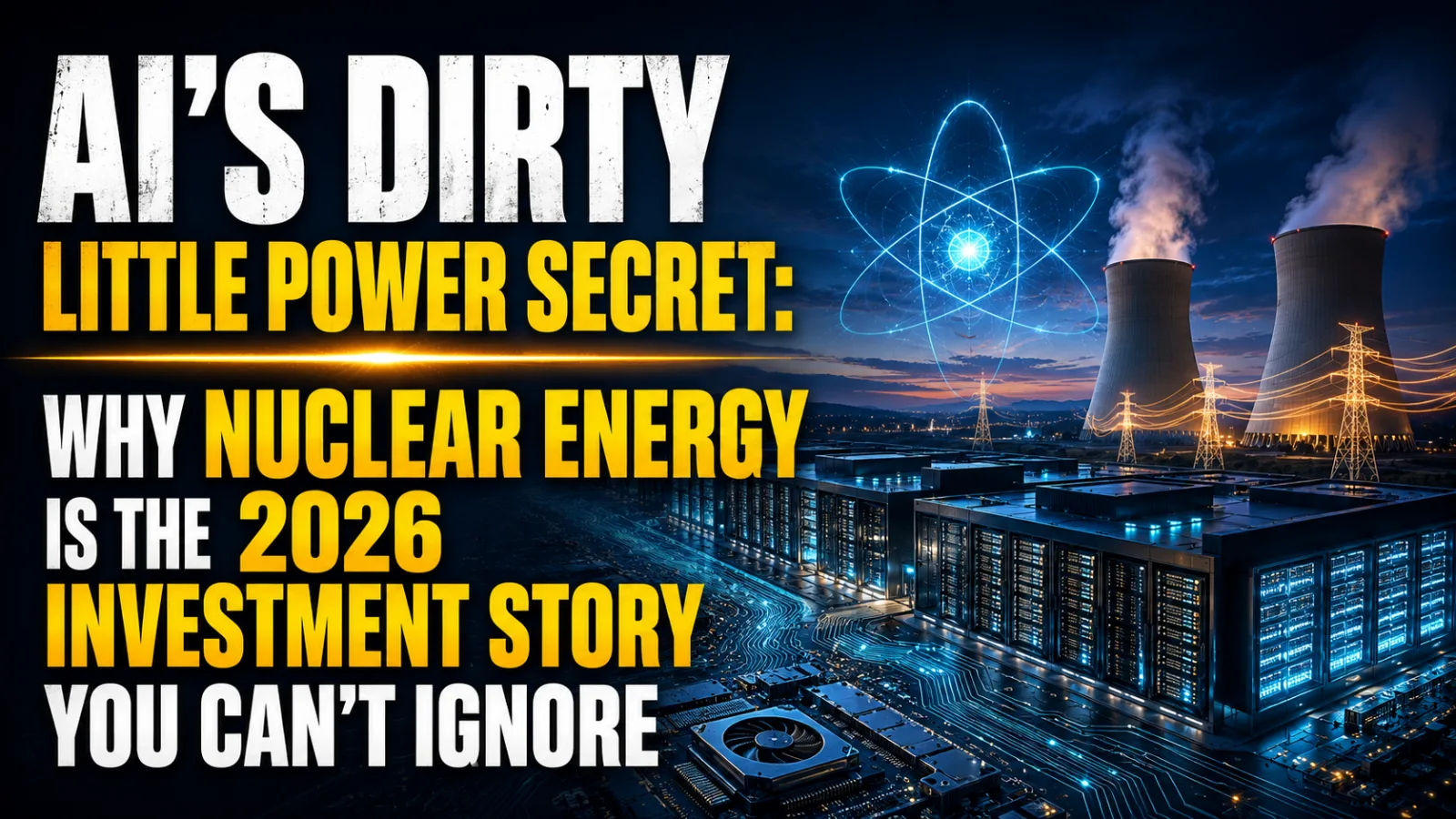
AI's real bottleneck isn't chips — it's round-the-clock power, and that has pushed nuclear and uranium back to the center of the 2026 investment conversation. Here's the structural thesis, the brutal volatility, the supply-chain choke points, and — for income investors — whether the nuclear boom can actually pay you.
For two years the AI story was told through silicon — who had the fastest chips, the biggest clusters, the cleverest models. In 2026 the plot twist arrived, and it wasn't a chip. It was a power cord. The companies building out AI have hit a hard physical wall: an around-the-clock appetite for electricity that intermittent wind and solar can't reliably feed.
That wall is why nuclear energy jumped from afterthought to headline. Reactors supply exactly what a 100,000-GPU training run needs and renewables can't promise — steady, carbon-free power that doesn't clock out when the wind drops or the sun sets. For investors, that turns a sleepy commodity corner into one of the loudest themes on the tape. It's also one of the most treacherous, and the numbers deserve some armor plating before you act on them. Look past the headline tickers and the real story is about the grid.
Takeaway #1: The AI infrastructure story is actually a grid story
The uranium thesis got supercharged the moment AI demand became a power-demand story. Data centers don't want "green when it's sunny" — they want firm, 24/7, low-carbon baseload, and that is nuclear's home court. Utilities are signing deals to feed AI campuses; some are reopening shuttered reactors and even pursuing dedicated plants for a single customer. The through-line: every incremental gigawatt of AI compute is an incremental bet on the atoms that can power it without interruption.
That's the part worth internalizing before you look at a single fund. You're not really buying "uranium" — you're buying the market's belief that the grid is the binding constraint on AI, and that nuclear is the least-bad way to relax it.
Takeaway #2: The brutal "mood swings" of commodity equities
Now the armor plating. Uranium equities are violently volatile — the kind of moves that would send a bond investor to the cardiologist. It is not unusual for a uranium-miner ETF to swing 20–30% in a month and then hand much of it back the next. The thesis is generational; the price action is jagged.
Which is why, in this corner of the market, position sizing matters more than market timing. A disciplined way to play it is as a thematic sleeve — a deliberate, capped slice of the portfolio (many allocators keep speculative single-theme exposure in the low single digits, roughly 2–5%) rather than a core holding. Chasing green candles here is how people buy the top; scaling in on weakness respects the fact that the bull case is measured in years while the drawdowns are measured in weeks.
Nuclear is the rare theme where the bull case is measured in decades and the pain is measured in weeks. Size for the first; survive the second.
Before you set that size, check what the volatility actually looks like — the Beta and drawdown readings for any basket you build sit on your Dividend Vision dashboard.
Takeaway #3: The growing chasm between spot and term prices
Here's the technical signal the pros actually watch: the gap between the spot price (uranium for immediate delivery) and the term price (what utilities lock in under multi-year contracts). Through the first half of 2026, spot consolidated around $85 a pound while the long-term contract price pushed past $94 — and it broke above $90 in January 2026 for the first time since 2008.
That divergence matters because utilities don't buy fuel at the gas station; they contract years ahead. A term price running well above spot says buyers are increasingly anxious to lock in future supply — and 2025 marked the thirteenth straight year in which utility contracting fell short of what reactors actually consume. Deferred buying doesn't disappear; it piles up, which tends to push utilities back into the market later with more to buy, fewer sellers, and less leverage. A rising term price can therefore signal the next leg up even while spot looks asleep.
Takeaway #4: Concentration risk and the sulfuric-acid choke point
The uranium trade is dangerously concentrated. The big miner ETFs — URA and URNM — lean heavily on two giants: Canada's Cameco (CCJ) and Kazakhstan's Kazatomprom. That creates real single-point-of-failure risk, and 2026 offered a live demonstration of a choke point almost nobody outside the sector talks about: sulfuric acid.
The acid bottleneck. Kazatomprom mines most of its uranium by in-situ recovery (ISR), which dissolves uranium underground using sulfuric acid. When acid is scarce, production slips — and it has been scarce, because roughly 60% of the world's sulfuric acid goes to agriculture, so uranium miners are effectively bidding against fertilizer. Kazatomprom cut its 2025 output guidance amid exactly this shortage.
It's not just Kazakhstan. In early July 2026, Cameco suspended its flagship Cigar Lake mine — the single most productive uranium mine on Earth — after the McClean Lake mill that processes its ore had to shut its sulfuric-acid plant for repairs. Production resumed on July 14 and Cameco held its full-year outlook, but a two-week stoppage at the best mine in the business, over an acid plant, is a tidy illustration of how brittle this supply chain is.
Geopolitics on top. Layer Kazakh production economics and Russia's outsized role in enrichment over all of that, and you have a supply base that can wobble on headlines few investors are pricing.
None of this breaks the long-term thesis. It's a reminder that supply here is fragile — and fragility cuts both ways: it fuels the bull case and it makes the ride lurch.
Takeaway #5: Diversified stability vs. speculative SMRs
By 2026, investors have effectively split the theme into a "mainstream" lane and a "speculative" lane.
The mainstream lane (NLR). The VanEck Uranium and Nuclear ETF blends miners with utility operators and reactor-services names — think Constellation Energy (CEG), Vistra (VST), and Talen (TLN). Adding regulated utilities dampens the commodity whipsaw and folds in businesses that can actually pay dividends. Its ~0.52% expense ratio is also the lowest of the major nuclear funds.
The speculative lane (SMRs and juniors). Small modular reactors — led by names like NuScale Power (SMR) and Oklo (OKLO) — are moving from design toward deployment, and they're the theme's high-beta lottery tickets: huge if they work, brutal if timelines and budgets slip. Junior miners (URNJ) offer more upside than the large-caps and even wilder swings.
| Ticker | What it holds | Role in a nuclear sleeve | Income profile |
|---|---|---|---|
| URA | Large uranium miners + reactor/component names | Core, most-liquid entry point | Variable distributions; growth-first |
| URNM | Pure-play miners + physical uranium (Sprott trust) | Concentrated commodity beta | Commodity-driven; income secondary |
| URNJ | Junior / small-cap uranium miners | Speculative upside, wildest swings | Appreciation, not income |
| NLR | Utilities + reactor operators + miners | Lower-beta, diversified anchor | Most income-oriented of the group |
| URCC | Covered calls written on uranium equities | Income overlay on the theme | Highest stated yield; caps upside |
Because AUM, yields, and holdings shift constantly, don't take any single snapshot as gospel — pull the live numbers for every fund above from the Nuclear collection, or screen and sort the 35+ nuclear names yourself in the nuclear ETF screener.
Takeaway #6: Can the nuclear boom actually pay you?
Nuclear is sold as a capital-appreciation story, so income investors reasonably ask the harder question: can this theme actually pay me while I wait? It can — but only if you choose carefully, because most of the uranium value chain is built for price appreciation, not dependable dividends.
Diversified nuclear ETFs: modest but real income. A broad fund like NLR holds utilities, reactor operators, and equipment providers alongside uranium names. Because regulated utilities and established infrastructure businesses tend to pay dividends, a utility-weighted nuclear fund is generally friendlier to income than a pure-miner basket. Miner-heavy funds (URA, URNM) may distribute, but the cash is lumpy — driven by uranium prices, mining economics, and sentiment, not a steady payout. Junior-miner funds (URNJ) sit at the speculative end; investors buy them for price moves, not income.
The income-labeled newcomers. The theme is now spawning funds engineered for cash flow rather than pure exposure. The Global X Uranium Covered Call ETF (URCC) writes call options against uranium equities, converting some of that famous volatility into option premium — a higher headline yield in exchange for capped upside. Newer entrants like the Nicholas Nuclear Income ETF (NUKX) put "income" in the name outright. Both can throw off attractive-looking distributions — just stay clear-eyed that an options-income wrapper on a volatile theme is still riding that theme.
Utilities: the more durable dividend. The sturdiest income in the nuclear story often isn't in the miners at all — it's in the companies that generate and sell the electricity. Constellation Energy (CEG), Vistra (VST), and Talen (TLN) benefit directly from rising power demand and long-term supply agreements, and they carry more traditional dividend characteristics than any uranium miner. Yields and payout growth vary widely, and some operators plow cash into plant upgrades and restarts, so a low current yield isn't automatically a weak business — sometimes it just means management is funding growth.
Three ways to approach nuclear income:
- Income-first. Favor diversified nuclear and utility exposure; weight dividend consistency and established cash flow over commodity upside.
- Total-return. Pair dividend-paying nuclear utilities with uranium miners, accepting a lower portfolio yield in exchange for more appreciation potential.
- Barbell. Hold a stable core (utilities or a diversified fund like NLR) alongside a smaller, speculative satellite (miners, juniors, SMR developers, or a covered-call fund). The stable side pays you and steadies the ride; the satellite keeps your exposure to uranium shortages, reactor restarts, and next-generation reactors.
For income investors, the barbell is often the sweet spot: you get paid on one side and keep the asymmetric upside on the other.
Don't confuse a distribution with a durable yield. A big headline rate is not the same as a safe one — especially on a thematic fund. Before you buy for income, check:
- Whether distributions come from recurring dividends or from capital gains and return of capital.
- How often the payout changes (a rate that lurches with the commodity isn't a salary).
- What the fund actually holds — utilities, miners, physical uranium, covered calls, or speculative developers.
- Total return after distributions, not just the yield.
- Expense ratio and single-name concentration.
- Whether the share price / NAV is quietly eroding underneath the payout.
In a volatile theme, a distribution doesn't make an investment conservative. Where the cash comes from is the whole question.
Dividend Vision tracks the nuclear complex — ETFs, miners, utilities, and SMR developers — in one place, so you can compare yields, distribution histories, total returns, expenses, holdings, and risk before deciding how (and whether) to participate. Browse it all in the Nuclear collection.
The long-term horizon vs. the headline ticker
Strip away the noise and one fact anchors the whole trade: the world is trying to build digital intelligence faster than the physical world can generate the power to run it. New mines and new reactors are coming, but their lead times are measured in years — and AI demand isn't waiting. That mismatch is the structural deficit, and analysts expect it to stretch well into the 2030s, with reactor requirements broadly projected to keep climbing toward 2040.
That's the case for looking past the weekly candle. It doesn't make the volatility go away, it doesn't fix the concentration risk, and it doesn't turn a uranium miner into a dividend aristocrat. What it does is frame the real question for a 2026 portfolio: do you bet on the chips that process the data, or the atoms that power the chips? You can, of course, own a little of both — just size the atoms for the ride they actually give you.
Ready to put numbers to the theme? Browse the Nuclear collection to see every fund and operator side by side, screen and sort the group in the nuclear ETF screener, use the income calculator to see what a given allocation would actually pay, and check Beta and drawdown on the dashboard before you commit.
Educational content, not investment advice. Ticker facts and the Nuclear collection reflect Dividend Vision data as of July 2026 and change constantly; prices, yields, AUM, and distributions are not guaranteed and may include return of capital. Uranium and nuclear equities are highly volatile, and past performance doesn't predict future results — always do your own research.