Best Of
Best Covered Call ETFs in 2026
ETFs that use options-writing strategies to generate enhanced income from equity positions.
Data updated October 2026 · 50 ETFs
The short answer
There is no credible promise of a covered-call ETF with no NAV erosion. A useful screen instead compares distribution-adjusted total return, NAV trend over a stated period, expense ratio, operating history, and how much upside the options overwrite. Read the NAV erosion methodology before treating a high distribution as earned income.
This page ranks active covered-call ETFs by assets under management, not by yield or a forward-looking safety claim. Market drawdowns, ex-distribution NAV drops, and return of capital tax labels are not automatically persistent economic erosion.
Who this page is for
Best for
- Income investors comfortable trading capped upside for premium income
- Portfolios that benefit from lower volatility during sideways markets
- Retirees who prioritize current income over capital appreciation
Not a fit for
- Bull-market maximalists — covered calls cap the best-case return
- Tax-sensitive accounts — most option premiums are taxed as ordinary income
- Investors expecting the fund to beat its underlying index during strong rallies
Analysis
Covered call ETFs use options-selling strategies to generate elevated income, typically trading some upside potential for steady cash distributions. This category spans 50 funds with an average yield of 20.09% and an average expense ratio of 0.71%, reflecting a wide range of underlying strategies and payout structures. JPMorgan dominates by sheer size, with JEPI ($45.7B) and JEPQ ($43.9B) representing the two largest funds in the top 10 shown. Other major issuers in this space include NEOS, Global X, Amplify ETFs, Goldman Sachs, First Trust, iShares, and Main Management, with NEOS notably running two large, newer entrants (QQQI and SPYI) that combine for roughly $27.4B in assets. All ten funds shown pay distributions monthly, consistent with the category's general emphasis on frequent income.
- The category-wide average yield of 20.09% is well above any yield seen among the top 10 funds shown (max 13.56% for QQQI), suggesting funds outside this subset likely carry substantially higher yields.
AI-generated analysis — AI can make mistakes. Verify important information independently. Not investment advice. AI risk disclosure
Risks specific to this category
- Capped upside: covered-call and option-overlay funds in this group keep the option premium in a rally but surrender gains above the strike, so they can trail the very index they write options against.
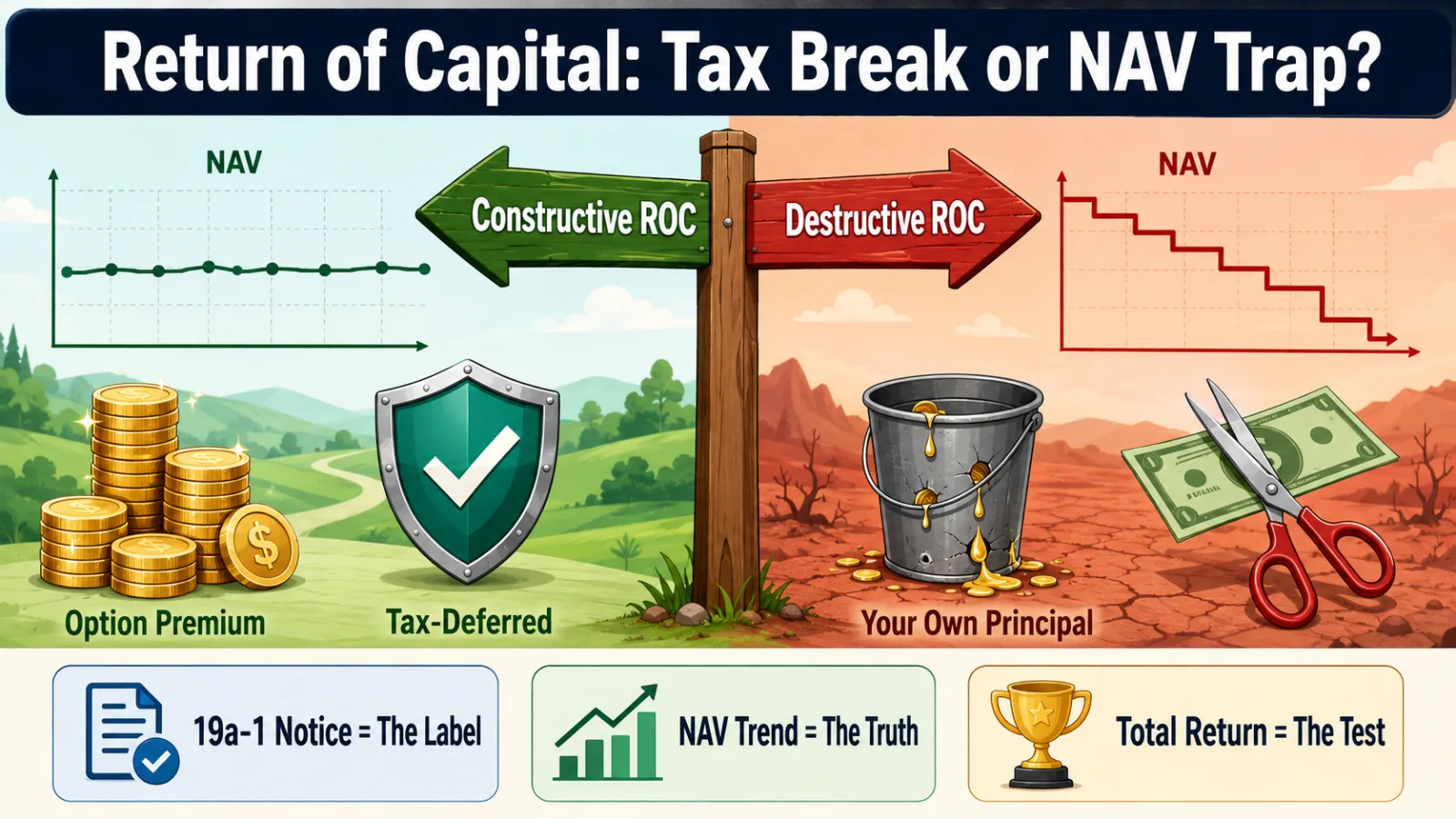
- Distribution sustainability: the average distribution rate here is 20.1%, and payouts at that level often include return of capital — when distributions persistently exceed total return, NAV erodes and shrinks the base that generates future income.
- Expense drag: expense ratios in this group average 0.71% — several times what broad index funds charge — and that cost compounds directly against total return.
- Short track records: 21 of the 50 funds launched within the last three years, so their distribution history is too short to judge payout durability across a full market cycle.
- Distributions are not contractual: each payout is declared period by period, so the yields on this page can fall without notice when portfolio income, option premium, or fund policy changes.
See this list inside your portfolio
A ranked list is a starting point. Dividend Vision turns it into a plan — forecasting the income your holdings actually generate and putting each fund's yield next to its total return and risk.
- Income forecasting — know what your holdings pay monthly, quarterly, and yearly
- Yield vs. total return — weigh each distribution against price performance, not the headline rate
- Screen & compare — line up any income ETFs side by side on yield, cost, and strategy
- Portfolio risk — see income concentration, issuer overlap, and volatility across your holdings
- AI ETF comparison — ask plain-language questions to compare yield, risk, and income potential
7 days of Pro included · no credit card · free plan afterward
Top picks
Top 3 covered call ETFs by assets under management.
Yield distribution
Expense ratio distribution
Income projection
Estimated income if the current average distribution rate of 20.09% held for a full year with share prices unchanged. Distribution rate is not total return—a fund can pay a large distribution while its share price falls—so treat these as an upper-bound illustration, not a forecast.
| Investment | Annual income | Monthly income | Weekly income |
|---|---|---|---|
| $10,000 | $2,009 | $167 | $39 |
| $25,000 | $5,024 | $419 | $97 |
| $50,000 | $10,047 | $837 | $193 |
| $100,000 | $20,095 | $1,675 | $386 |
Issuer breakdown
Distribution of ETFs by fund issuer, showing how concentrated or varied the sponsor lineup is.
How this list is built
"Best" here means the selection rule below, applied to our own data — not an opinion poll and not a prediction:
- Universe: every security in our database matching this category — 235 qualified as of October 2026.
- Exclusions: liquidated, delisted and renamed funds drop out automatically; a renamed fund's successor appears in its place.
- Ordering: assets under management, largest first.
- Cap: the top 50 are shown; 185 further matching funds are not listed here. Use the screener for the complete set.
- Independence: no placement on this page is paid, sponsored, or influenced by a fund issuer.
All 50 ETFs
| Ticker | Name | Issuer | Yield | Expense ratio | AUM | Frequency |
|---|---|---|---|---|---|---|
| JEPI | JPMorgan Equity Premium Income ETF | JPMorgan | 7.30% | 0.35% | $45.7B | Monthly |
| JEPQ | JPMorgan Nasdaq Equity Premium Income ETF | JPMorgan | 11.14% | 0.35% | $43.9B | Monthly |
| QQQI | NEOS Nasdaq-100 High Income ETF | NEOS | 13.56% | 0.68% | $15.0B | Monthly |
| SPYI | NEOS S&P 500 High Income ETF | NEOS | 11.95% | 0.68% | $12.4B | Monthly |
| QYLD | Global X Nasdaq 100 Covered Call ETF | Global X | 11.38% | 0.60% | $8.5B | Monthly |
| DIVO | Amplify CWP Enhanced Dividend Income ETF | Amplify ETFs | 4.85% | 0.56% | $7.9B | Monthly |
| GPIQ | Goldman Sachs Nasdaq-100 Premium Income ETF | Goldman Sachs | 10.52% | 0.29% | $6.1B | Monthly |
| GPIX | Goldman Sachs S&P 500 Premium Income ETF | Goldman Sachs | 8.53% | 0.29% | $6.0B | Monthly |
| XYLD | Global X S&P 500 Covered Call ETF | Global X | 8.52% | 0.60% | $3.4B | Monthly |
| KNG | FT Vest S&P 500 Dividend Aristocrats Target Income ETF | First Trust | 8.58% | 0.74% | $3.3B | Monthly |
| FTHI | First Trust BuyWrite Income ETF | First Trust | 9.04% | 0.75% | $2.5B | Monthly |
| TLTW | iShares 20+ Year Treasury Bond BuyWrite Strategy ETF | iShares | 17.34% | 0.35% | $1.7B | Monthly |
| IDVO | Amplify CWP International Enhanced Dividend Income ETF | Amplify ETFs | 6.12% | 0.65% | $1.5B | Monthly |
| BALI | iShares U.S. Large Cap Premium Income Active ETF | iShares | 6.15% | 0.35% | $1.4B | Monthly |
| BUYW | Main Buywrite ETF | Main Management | 6.05% | 0.99% | $1.4B | Monthly |
| NVDY | YieldMax NVDA Option Income Strategy ETF | YieldMax | 35.42% | 1.09% | $1.4B | Weekly |
| BTCI | NEOS Bitcoin High Income ETF | NEOS | 25.42% | 0.98% | $1.4B | Monthly |
| RYLD | Global X Russell 2000 Covered Call ETF | Global X | 11.35% | 0.60% | $1.3B | Monthly |
| CHPY | YieldMax Semiconductor Portfolio Option Income ETF | YieldMax | 39.14% | 1.03% | $1.3B | Weekly |
| IWMI | NEOS Russell 2000 High Income ETF | NEOS | 14.73% | 0.68% | $1.3B | Monthly |
| ISPY | ProShares S&P 500 High Income ETF | ProShares | 6.31% | 0.56% | $1.2B | Monthly |
| OMAH | VistaShares Target 15 Berkshire Select Income ETF | VistaShares | 15.37% | 0.98% | $1.1B | Monthly |
| MSTY | YieldMax MSTR Option Income Strategy ETF | YieldMax | 98.88% | 1.03% | $1.1B | Weekly |
| EIPI | FT Energy Income Partners Enhanced Income ETF | First Trust | 6.94% | 1.11% | $1.1B | Monthly |
| FTQI | First Trust Nasdaq BuyWrite Income ETF | First Trust | 11.95% | 0.75% | $992M | Monthly |
| QDTE | Roundhill Nasdaq-100® 0DTE Covered Call Strategy ETF | Roundhill Investments | 19.52% | 0.96% | $983M | Weekly |
| QDVO | Amplify CWP Growth & Income ETF | Amplify ETFs | 11.07% | 0.56% | $779M | Monthly |
| ROCY | JPMorgan Equity Premium Yield ETF | JPMorgan | 6.64% | 0.35% | $752M | Monthly |
| FEPI | REX FANG Covered Call ETF | REX Shares | 24.96% | 0.65% | $727M | Weekly |
| ULTY | YieldMax Ultra Option Income Strategy ETF | YieldMax | 59.55% | 1.40% | $721M | Weekly |
| TSLY | YieldMax TSLA Option Income Strategy ETF | YieldMax | 53.75% | 1.07% | $691M | Weekly |
| ROCQ | JPMorgan Nasdaq Equity Premium Yield ETF | JPMorgan | 10.45% | 0.35% | $671M | Monthly |
| HNDL | Strategy Shares Nasdaq 7 Handl Index ETF | Strategy Shares | 7.15% | 0.94% | $627M | Monthly |
| IAUI | NEOS Gold High Income ETF | NEOS | 12.47% | 0.79% | $626M | Monthly |
| TDVI | FT Vest Technology Dividend Target Income ETF | First Trust | 7.80% | 0.75% | $611M | Monthly |
| SIXH | ETC 6 Meridian Hedged Equity-Index Option Strategy ETF | Exchange Traded Concepts | 1.98% | 0.69% | $606M | Monthly |
| IGLD | FT Vest Gold Strategy Target Income ETF® | First Trust | 7.06% | 0.85% | $593M | Monthly |
| WTPI | WisdomTree Equity Premium Income Fund | WisdomTree | 12.10% | 0.44% | $528M | Monthly |
| IDUB | Aptus International Enhanced Yield ETF | Aptus | 5.12% | 0.44% | $518M | Quarterly |
| PAPI | Parametric Equity Premium Income ETF | Morgan Stanley | 7.99% | 0.29% | $486M | Monthly |
| AIPI | REX AI Covered Call ETF | REX Shares | 34.44% | 0.65% | $470M | Weekly |
| AMDY | YieldMax AMD Option Income Strategy ETF | YieldMax | 98.39% | 1.00% | $451M | Weekly |
| IQQQ | ProShares Nasdaq-100 High Income ETF | ProShares | 6.25% | 0.55% | $408M | Monthly |
| CONY | YieldMax COIN Option Income Strategy ETF | YieldMax | 68.65% | 1.04% | $392M | Weekly |
| PBP | Invesco S&P 500 BuyWrite ETF | Invesco | 9.67% | 0.29% | $387M | Monthly |
| TDAQ | TappAlpha Innovation 100 Growth & Daily Income ETF | TappAlpha | 16.58% | 0.83% | $386M | Monthly |
| PLTY | YieldMax PLTR Option Income Strategy ETF | YieldMax | 32.53% | 1.07% | $375M | Weekly |
| YMAX | YieldMax Universe Fund of Option Income ETF | YieldMax | 40.78% | 1.33% | $371M | Weekly |
| XQQI | NEOS Boosted Nasdaq-100 High Income ETF | NEOS | 19.58% | 0.98% | $366M | Monthly |
| IVVW | iShares S&P 500 BuyWrite ETF | iShares | 23.71% | 0.25% | $351M | Monthly |
Frequently asked questions
What are the best covered call ETFs?
This page lists the top 50 ETFs in this category ranked by key metrics. The list includes funds from issuers like JPMorgan, NEOS, Global X and more.
How often is this list updated?
The data on this page is refreshed regularly using the latest available distribution rates, expense ratios, and AUM figures. Last updated October 2026.
What is the average yield of these ETFs?
The average distribution yield across the 50 ETFs on this list is 20.09%. Individual yields range from 1.98% to 98.88%.
How does a covered call strategy work?
The fund owns stocks (or an index) and sells call options against those positions. The option buyer pays a premium for the right to buy the stock at a set price. If the stock stays below that price, the fund keeps the premium as income. If the stock rises above, the fund's gain is capped at the strike price.
How do JEPI, JEPQ, QQQI, SPYI, QDTE, and XDTE differ?
They split on two axes: the index underneath and how the options are written. JEPI and SPYI write against S&P 500 exposure; JEPQ, QQQI, and QDTE against the Nasdaq-100; XDTE against the S&P 500. On strategy, JEPI and JEPQ hold actively selected stocks with an equity-linked-note overlay and pay monthly; QQQI and SPYI use out-of-the-money index options designed for favorable tax treatment and pay monthly; QDTE and XDTE sell same-day (0DTE) options and pay weekly. The head-to-head pages linked under Related compare each pairing in detail.
Do covered call ETFs lose money in bear markets?
Yes, but typically less than their underlying index. The options premiums collected provide a partial buffer against losses. However, in a severe downturn, the premiums won't fully offset the decline in the underlying holdings.
What's the difference between index and single-stock covered call ETFs?
Index-based covered call ETFs (like JEPI, QYLD) sell options on broad indices, offering diversified, moderate premiums. Single-stock covered call ETFs (like TSLY, NVDY) sell options on individual volatile stocks, generating higher premiums but carrying concentration risk tied to one company's performance.
Looking for the complete list?
This page is our editorial shortlist, selected and ordered by the rule above. For every fund we track in this category, with live filtering, see the full covered call etfs list.
Explore more
Learn the method
The metrics and risks behind this list, explained in the Academy.
From the blog

Put this list to work in your portfolio
Import or build a portfolio to see income forecasts, upcoming distributions, income concentration, and risk across everything you own — and where a fund's yield and total return diverge.
7 days of Pro included · no credit card · free plan afterward