Grand Theft Autocallable: Who Gets the Upside?

Three market paths, one $1,000 note, and a closer look at what you give up for that eye-catching income.
MISSION BRIEFING. The target: double-digit income. The getaway driver: a note that can end early. The twist: the market can rally without taking your investment along for the ride. And if it falls far enough, you can lose principal.
Nobody's stealing anything. The trade is in the prospectus. It just reads better with a getaway car.
The one-line version: an autocallable pays you like a heist that's already been planned. Fixed take, set dates, and everything goes fine unless the alarm trips.
Here is why that matters right now. Our Autocallable directory lists 34 funds holding about $6.3 billion, and the oldest of them is 17 months old. The fund at the top of the rate column shows a 100.10% distribution rate. Through November 20 it had also lost 51.4% since late May, distributions included. Both numbers are true at once. This article shows how.
Key takeaways
- An autocallable pays a coupon only when its reference asset clears a line on a scheduled check date. The coupon is a fixed take, not a share of the upside.
- A rally ends the note early. You get your money back and no part of the gain.
- At the end, a barrier is all or nothing: finish below it and you take the full loss from the start, not just the part past the line.
- An ETF holds a ladder of these notes. Your shares can fall well below what you paid even while individual notes still have protection at maturity.
- In the month through November 20, 2026, the autocallable ETFs on our list lost anywhere from 0.8% to 35.3%. The label does not tell you which kind you own.
The cheat sheet
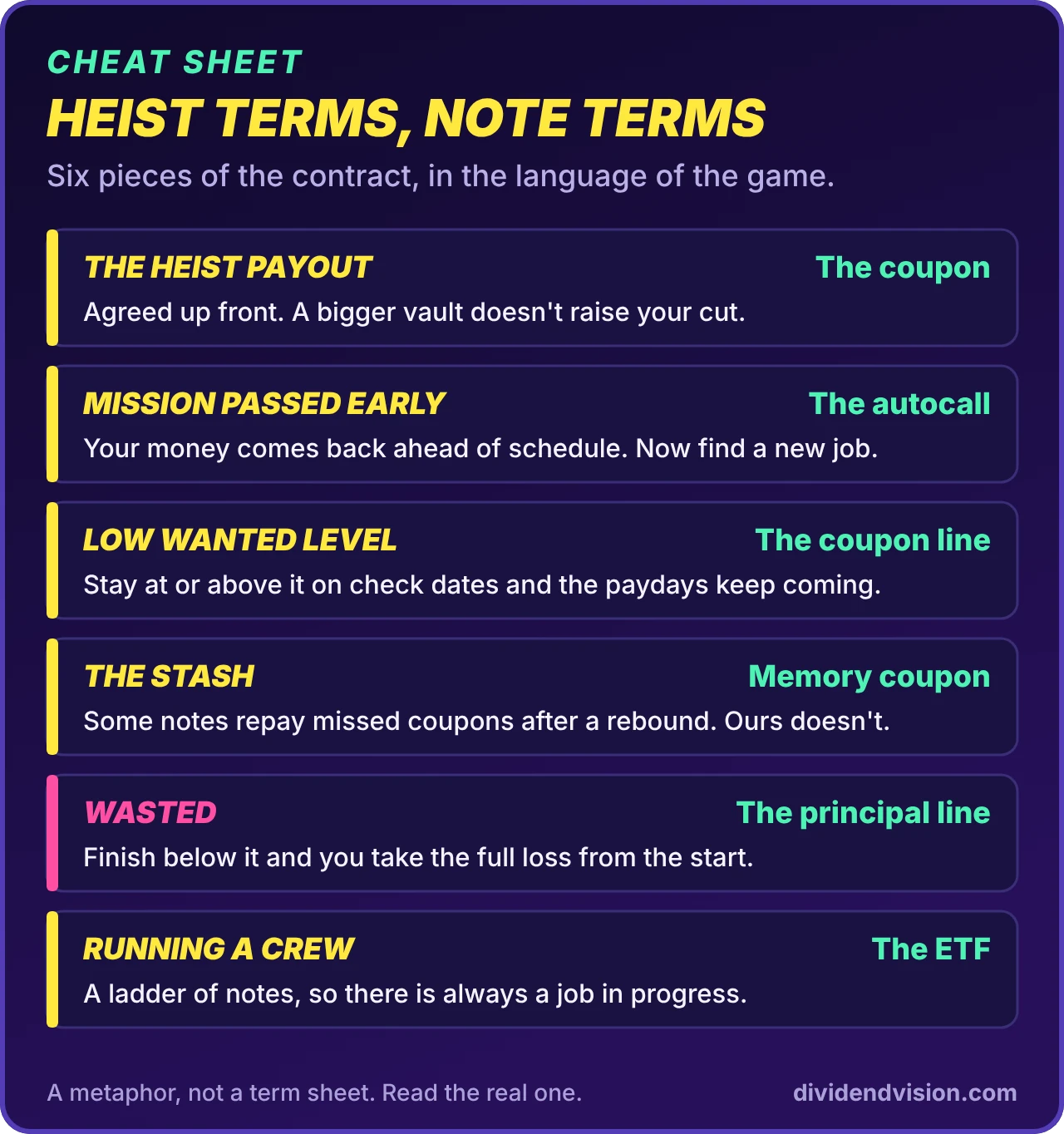
If you've spent any time lately pulling heists in a certain open-world game, you already know the moves.
| In the game | In the note | What it means |
|---|---|---|
| The heist payout | The coupon | The take is agreed before anyone walks into the bank. A bigger vault doesn't raise your cut. |
| Mission passed, early | The autocall | Your money comes back ahead of schedule. Then you need a new job, at whatever the going rate is. |
| Keeping your wanted level low | The coupon line | Stay at or above it on check dates and the paydays keep coming. Dip below and that period pays nothing. |
| The stash | Memory coupon | Some notes repay missed coupons after a rebound, like loot you hid during a chase. Many don't. |
| Wasted | The principal line | Finish below it and you eat the whole loss from the start. Hospital bill, no partial credit. |
| Running a crew | The ETF | One note is one heist. A fund runs a ladder of them, so there is always a job in progress. |
What's under the hood?
An autocallable note is a contract that can end on its own. A bank typically issues the note, and its terms tie your payments to a reference asset: a stock, an index, or sometimes a basket. You don't own that asset. You own a promise of payments under a set of rules, and if you hold the note directly, the issuer has to be able to make good on that promise. The SEC investor bulletin on structured notes covers the basics.
So where does the coupon come from? Not from dividends, and not from interest on a loan. In effect, you are selling insurance against a big fall in the reference asset. The coupon is the premium you collect. A broken principal line is the claim you pay out. High coupons mean the market thinks that claim is more likely.
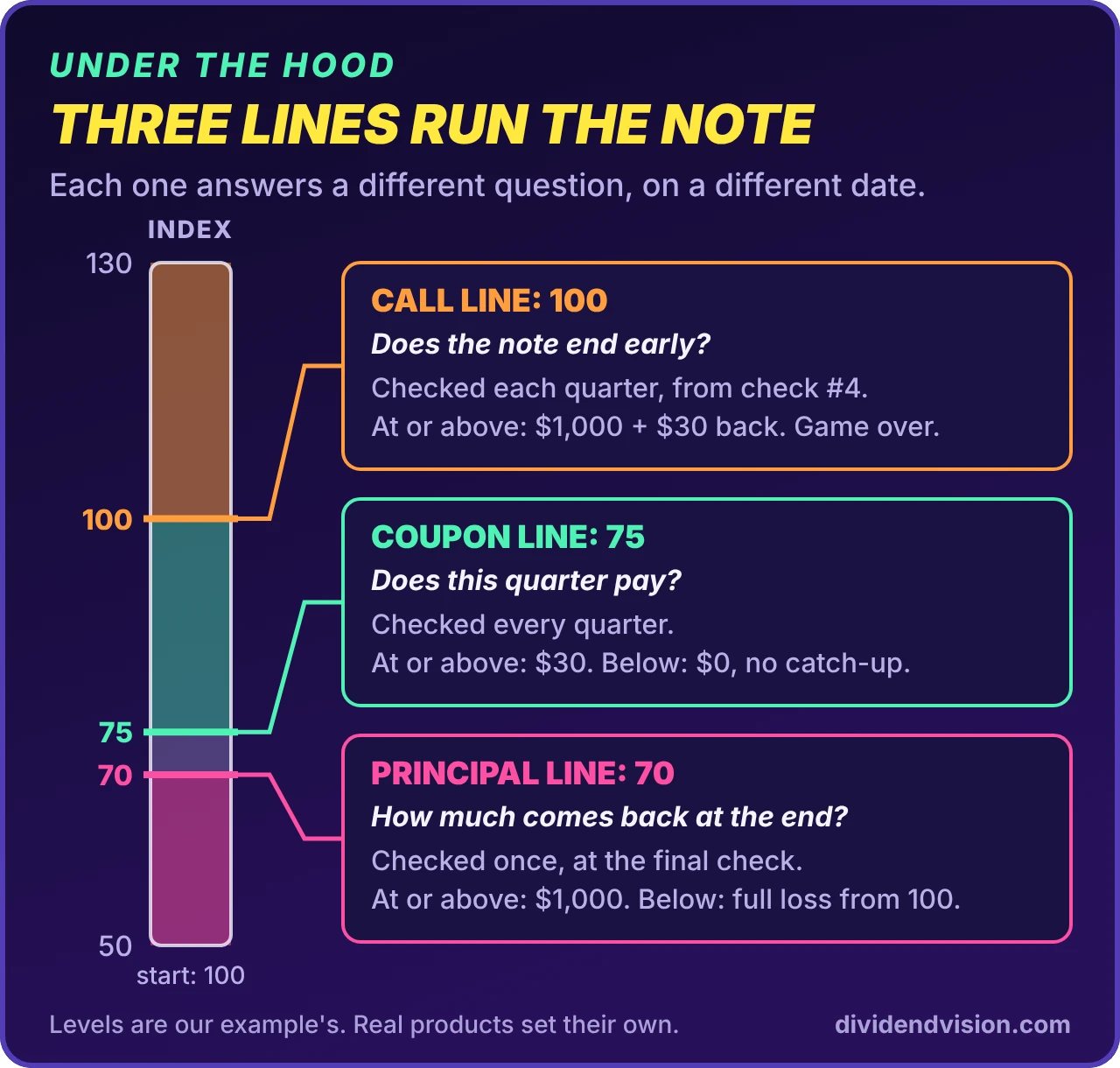
Think of the contract as having three controls. The coupon line decides if a payment is earned on a check date. The call line decides if the note shuts off early once it's eligible; nobody needs to place a trade or pick up a phone. The principal line decides how much comes back if the note reaches the end. Those controls can sit at different levels. In our example, an index at 80 earns a coupon but doesn't trigger a call. Some products can recover missed coupons after a rebound; ours can't.
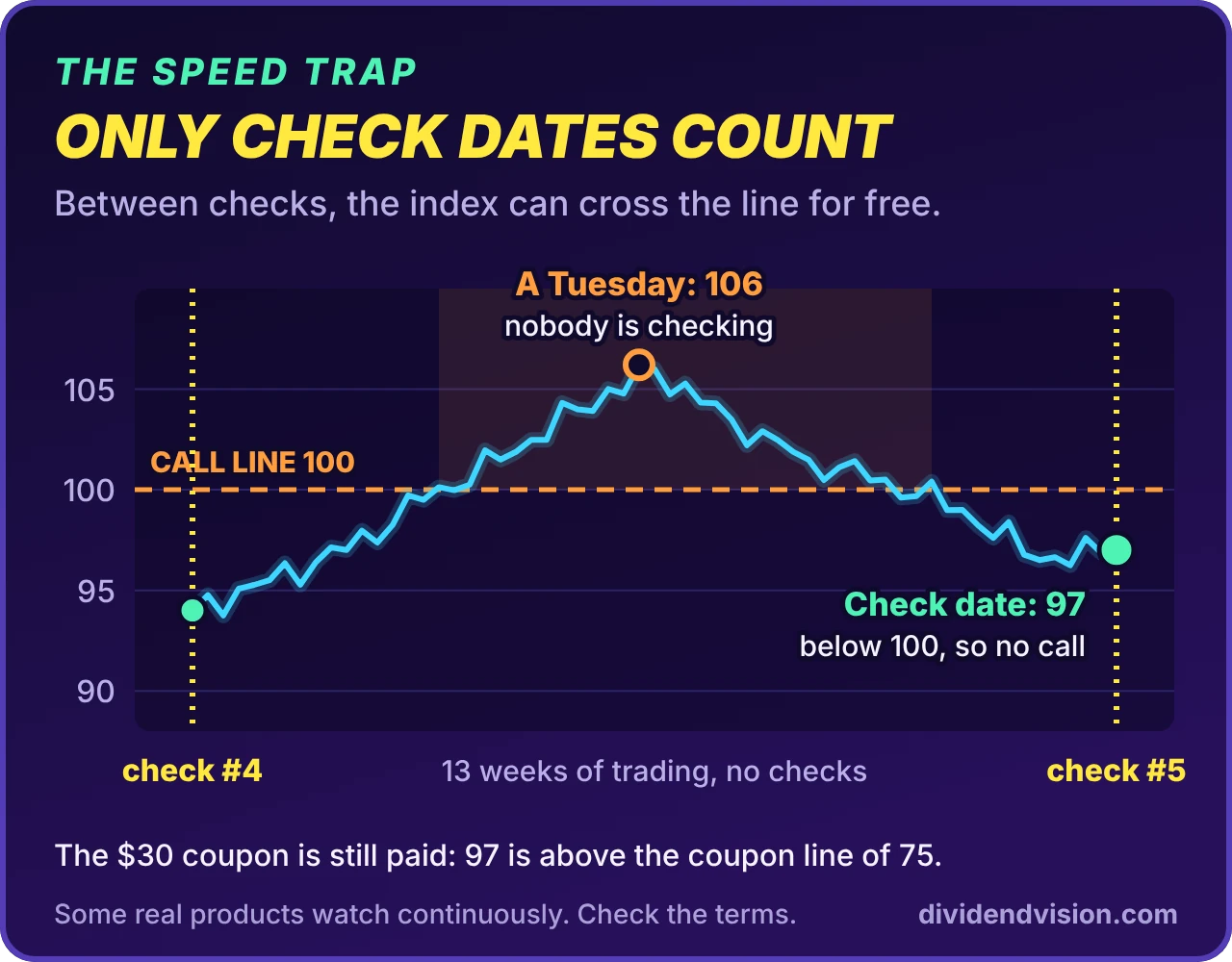
The speedometer between checkpoints can be misleading. In our example, hitting 100 on a Tuesday doesn't call the note if the scheduled check is on Friday and the index closes below 100 then. Likewise, a principal line that applies at maturity doesn't keep your note or your ETF shares from losing market value along the way. Always check whether a real product measures its lines on set dates, at maturity, or continuously.
The test drive: one $1,000 note
This is the kind of payoff an ETF might get exposure to. The numbers describe one fictional note, not a forecast for ETF shareholders.
| Spec | Our fictional note |
|---|---|
| Price | $1,000 |
| Term | Up to two years, with a check every quarter (eight in all) |
| Reference | An index that starts at 100. You don't own it. |
| Coupon | $30 per quarter if the index is at or above 75 on that quarter's check. That's 12% a year if all four pay, not a promised yield. |
| Memory | None. A missed coupon is gone. |
| Early call | From the fourth check on, an index at or above 100 ends the note. It pays $1,000 plus that quarter's coupon, and nothing after. |
| Principal at the end | $1,000 back if the index finishes at or above 70. Below 70, you take the index's full percentage loss from 100. |
That last row is a barrier, not a buffer that absorbs the first 30% of losses. We'll come back to the difference, because it's worth $300 in Mission 3.
All three missions ignore taxes, fees, reinvestment and issuer default.
Mission 1: The rally. The getaway car leaves early.
The index reads 90, 95, 98, then 125 at the first four quarterly checks. You collect all four coupons. The fourth check triggers the call.
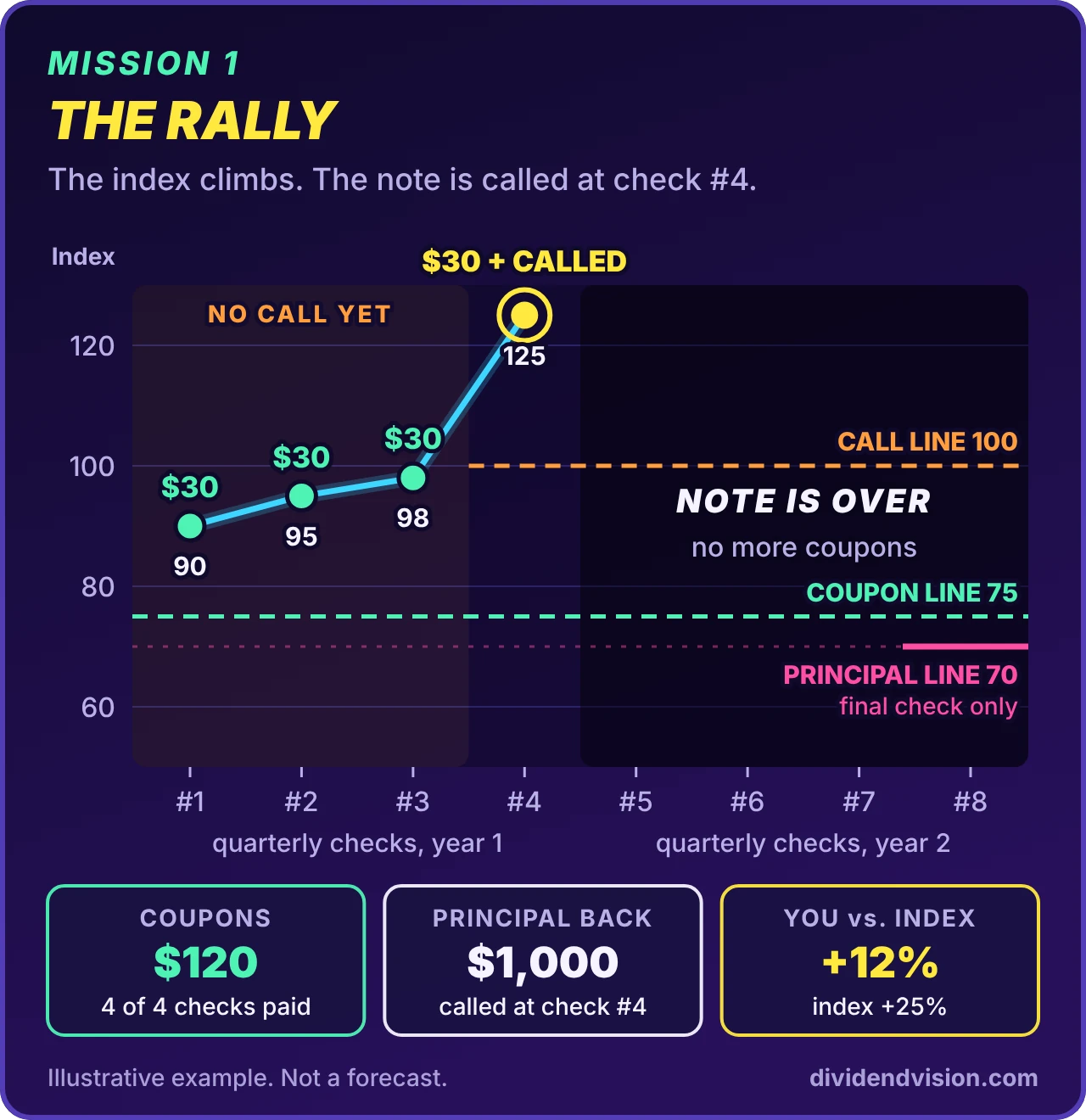
Your result: $1,000 back plus $120 in coupons, a 12% gain over one year. The index rose 25% on the same path. You get none of that extra upside.
Call it fast travel. You arrived early, and the scenic route, the rally, went by without you. If you want to keep earning income, you now have to find somewhere else to put the money, and the next deal may pay less.
Mission 2: Stop-and-go traffic. Two paydays disappear.
The index reads 95, 73, 80, 97, 72, 88, 90, then 92. It never triggers a call. It dips under the coupon line twice, and the later recovery doesn't restore either payment.
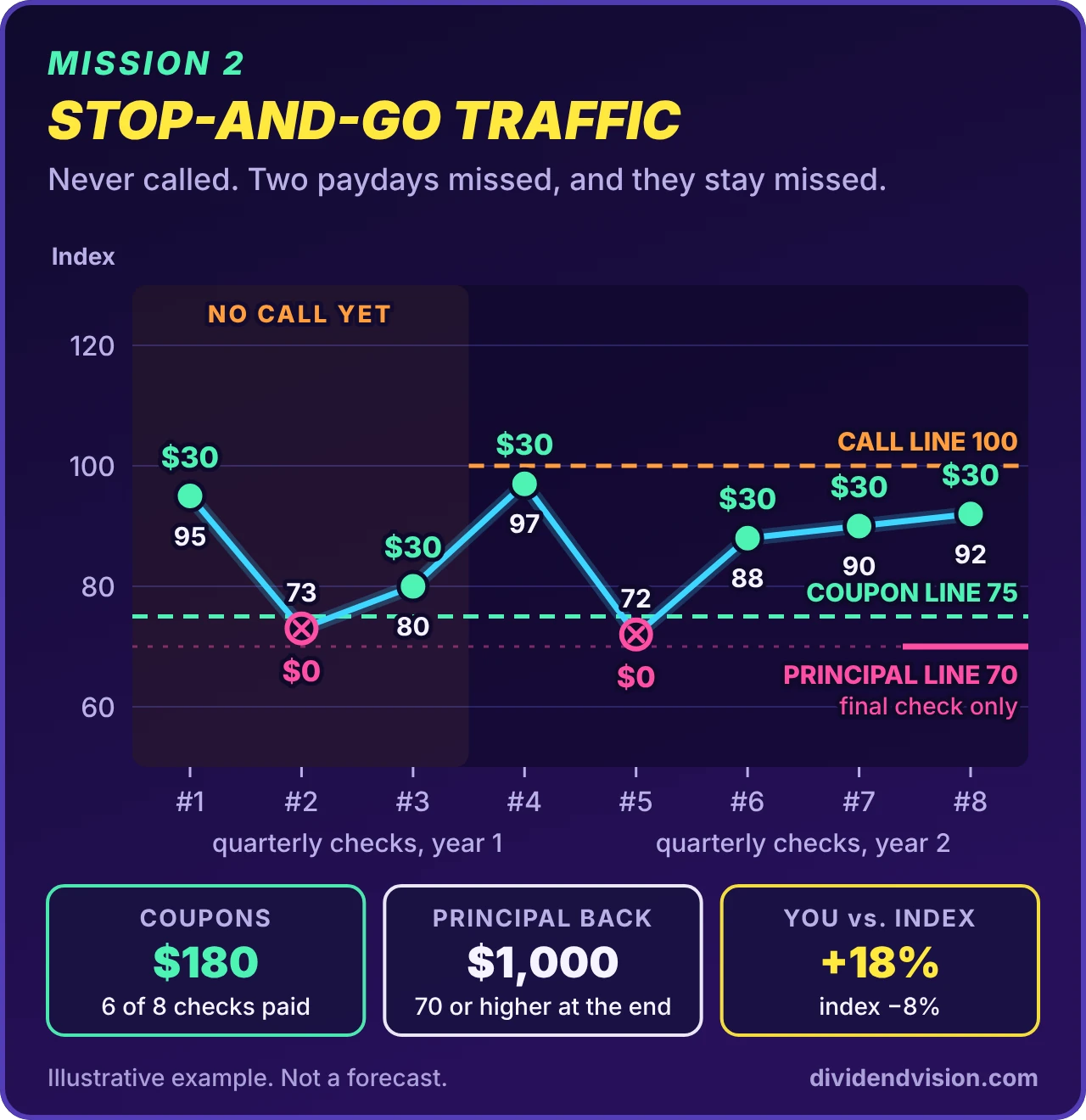
Your result: $1,000 back plus six $30 coupons, an 18% cumulative gain over two years. This is where the trade can work well: the index finishes down 8%, but stays high enough on enough check dates for the note to earn income and return principal.
Mission 3: The sell-off. Mind the guardrail.
The index reads 95, 85, 74, 68, 65, 69, 63, then 60. Only the first two checks pay coupons. At the final check the index is 40% below its starting level, so principal is cut by the full 40%.
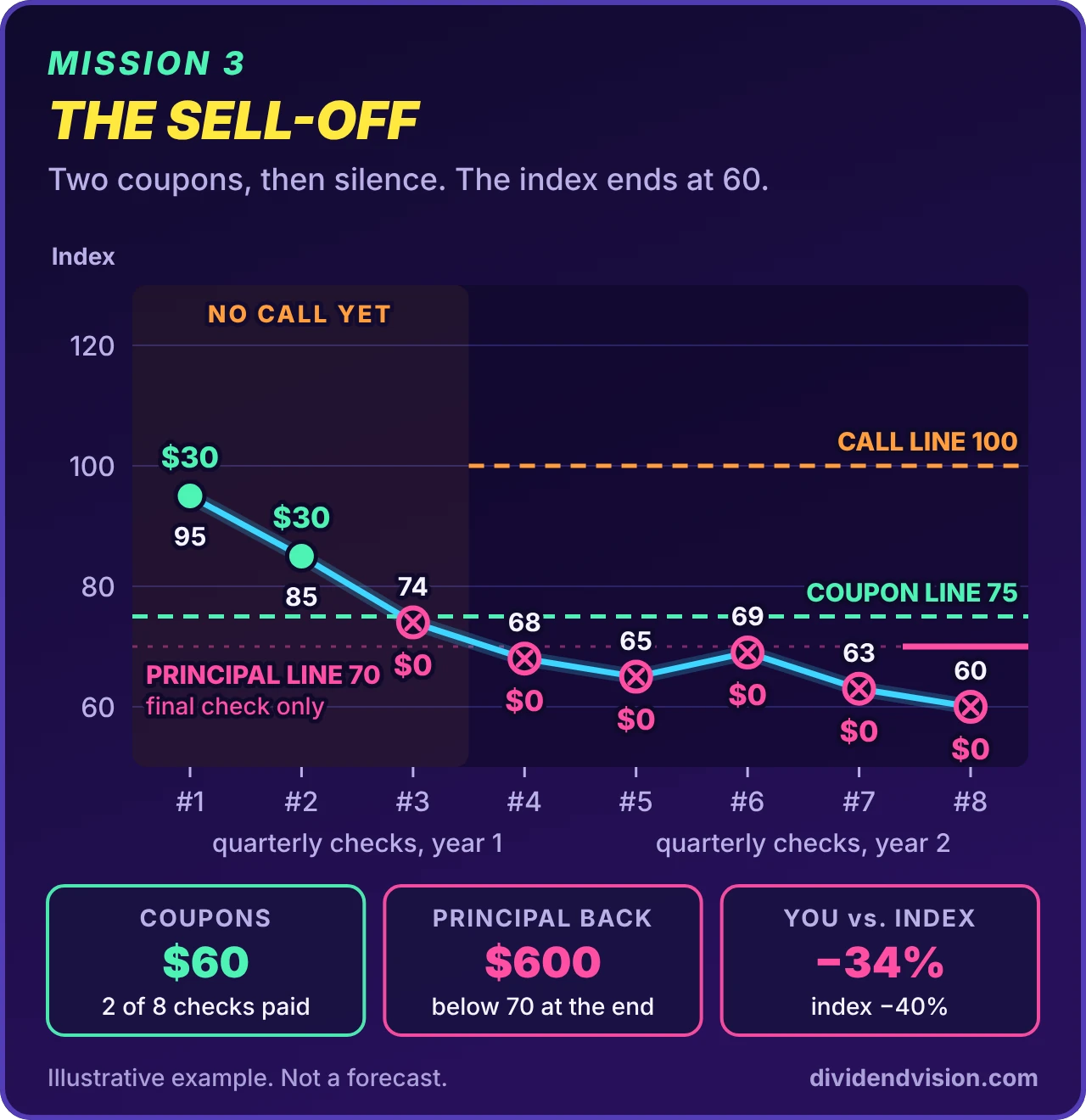
Your result: $600 in principal plus $60 in coupons, a 34% loss. Wasted. And there are no save points: when a line breaks, you can't reload the last checkpoint.
The scoreboard
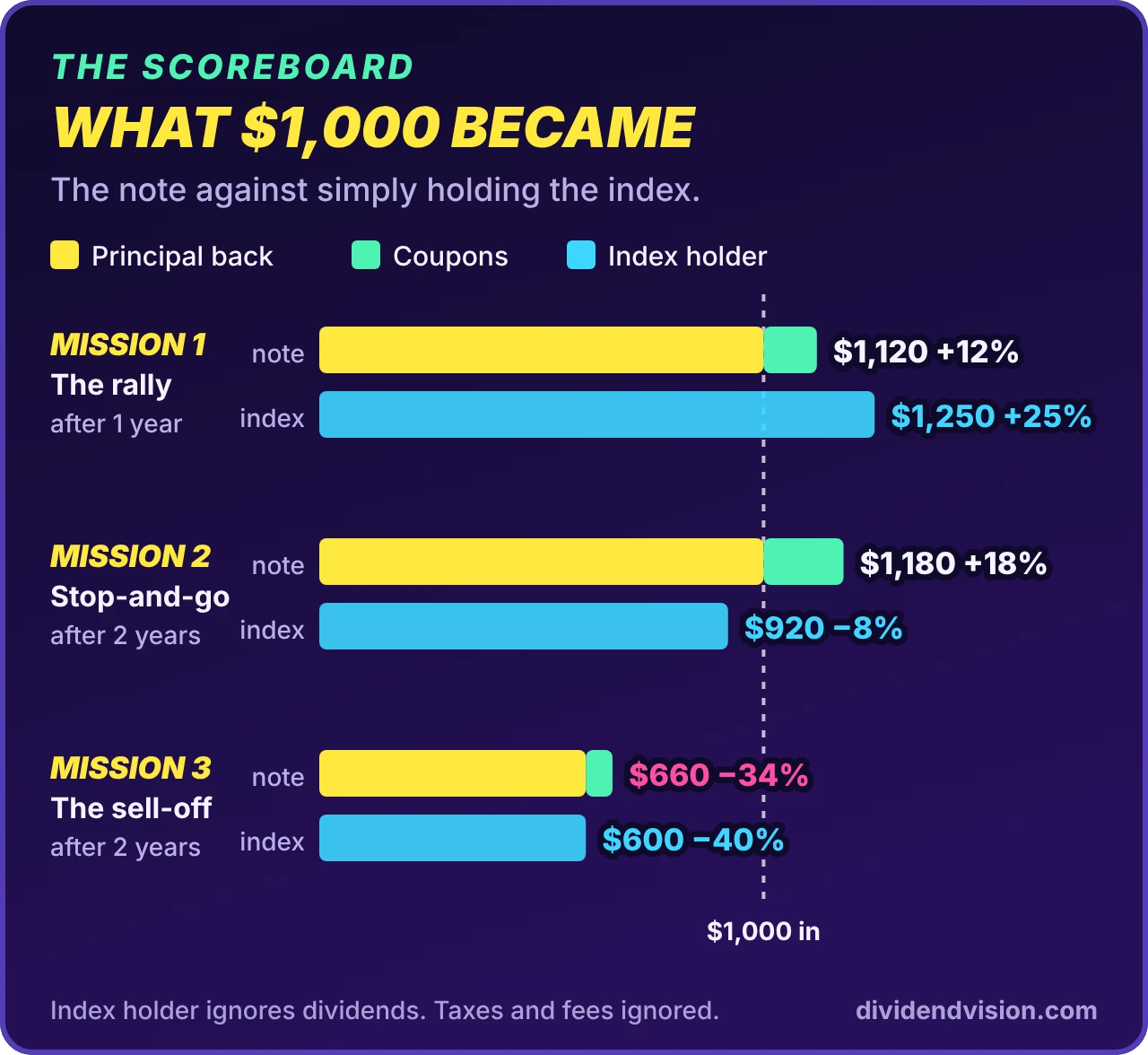
| Mission | Coupons paid | Principal back | Note result | Index result |
|---|---|---|---|---|
| 1. The rally | 4 of 4 | $1,000 | +12% in one year | +25% |
| 2. Stop-and-go | 6 of 8 | $1,000 | +18% in two years | -8% |
| 3. The sell-off | 2 of 8 | $600 | -34% in two years | -40% |
Two things stand out.
Your ceiling is fixed. The most this note can ever pay is eight coupons: $240, or 24% over two years. To collect all eight, the index has to stay at or above 75 on every check and stay below 100 on checks four through seven. Your best case needs the market to go nowhere for most of two years. Good news for the index cuts your coupon count short: the rally in Mission 1 ended the note after four coupons, and whether the next note pays as well is a new question.
Your floor is not. In Mission 3 the coupons softened the fall by six points. They did not stop it.
Wasted, or just dented? Barrier versus buffer
"Downside protection" covers two very different guardrails.
A barrier is a cliff. At or above 70 at the end, you get everything back. One point below, the protection is gone and you own the entire decline from 100.
A buffer absorbs the first part of the loss and leaves you with the rest. With a true 30% buffer, the same 40% drop in Mission 3 would cost you 10% of principal, not 40%.
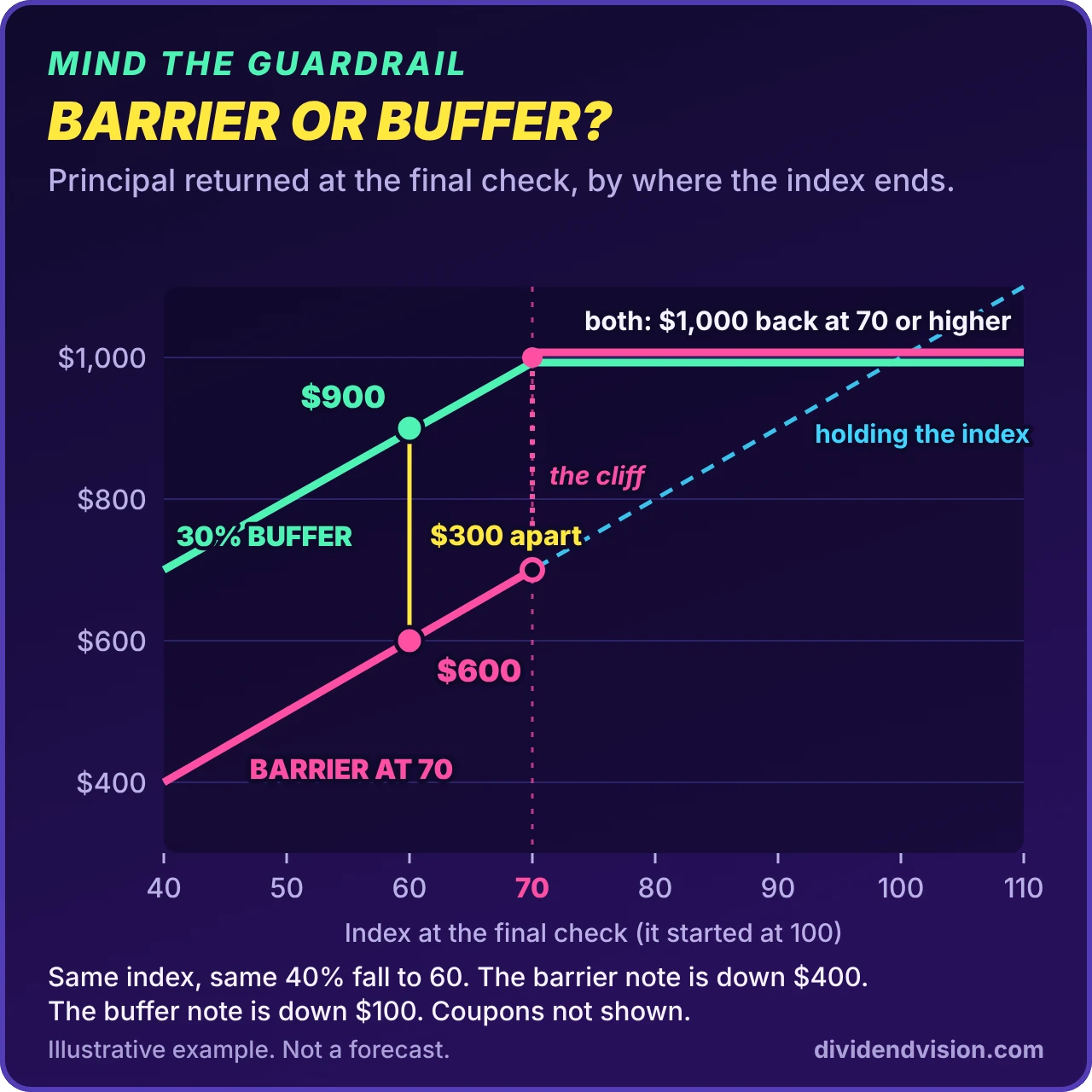
Same index, same fall to 60: $600 back from the barrier note, $900 from the buffer note. Which one you own matters a lot more than the label on the front.
Same engine, different ride: the ETF
One note is one heist. An autocallable ETF runs a crew. It holds a ladder of notes started on different dates, with different start levels and check dates, so there is always a job in progress. When one note gets called, the ETF doesn't close or hand back your purchase price. The strategy rolls into new notes at whatever terms are on offer that day.
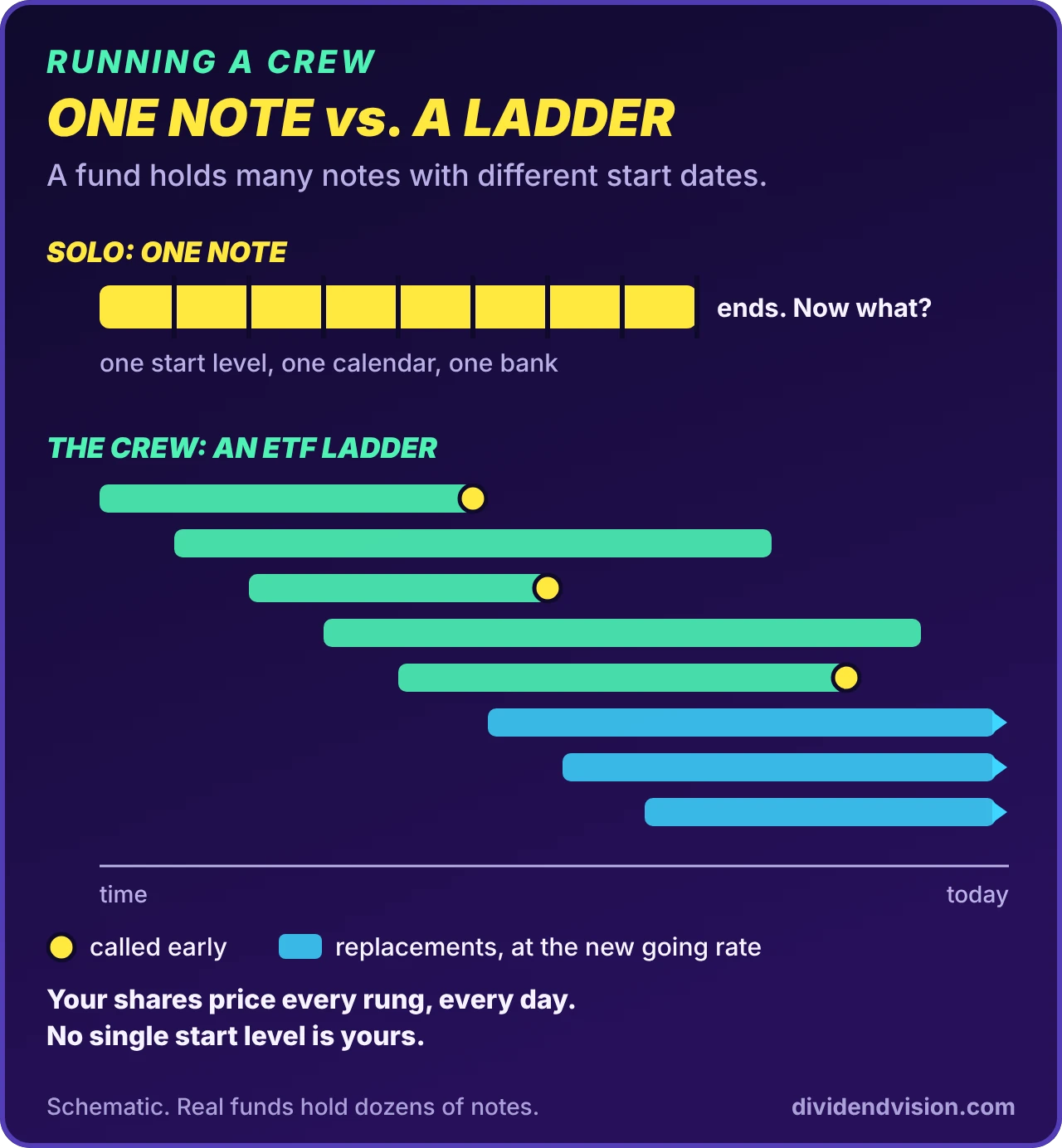
That smooths the income. It also blurs what you can predict about any single payout, and it changes what "protection" means for you: your ETF shares can trade below what you paid even when individual notes still have protection at maturity. The lines belong to each note. Your purchase price isn't one of them.
| One structured note | An autocallable ETF | |
|---|---|---|
| Getting out | Built to be held to the end. Selling early usually means the bank's price. | Trades all day on an exchange, at the market's price. |
| Who owes you | One bank. If it fails, the promise fails with it. | The fund, and behind it the counterparties to its swaps or options. |
| Timing | One start level, one calendar, one maturity. | Many notes, staggered. Called money is redeployed for you. |
| After a call | Cash in hand. Finding the next job is on you. | The manager finds it, at the new going rate. |
| What you can see | A term sheet with your exact levels. | A blend of many levels that changes every week. |
Many of these funds don't buy bank notes at all. CAIE and PAYM, for example, describe holding Treasuries and cash-like assets and getting the autocallable payoff through total return swaps. DACL and MPIM describe the same swap route to a ladder of synthetic notes. Others, such as ARKY, say they invest in the notes directly. Either way, someone on the other side of a contract has to pay, and the bank is still part of the crew.
For a real-world contrast with our fictional note, Amplify's summary prospectus for YO, dated November 16, 2026, describes swap exposure to an index of laddered autocallables, a 25% buffer on individual contracts at maturity, and a memory feature that can recover missed coupons if the payment conditions are later met. The same document says the fund itself "does not provide any stated buffer against losses." The rules in our fictional note are different on purpose.
The real garage: 34 funds, $6.3 billion
Enough fiction. Here is what's on the lot, using Dividend Vision data through November 20, 2026.
- 34 funds from 11 issuers carry the Autocallable tag, with about $6.3 billion between them.
- Two funds, ACYN and CAIE, hold 65% of the money.
- The first, CAIE, launched on June 25, 2025. Six funds launched in 2025 and the rest in 2026. New ones are still arriving: MEA, built on Meta, listed in mid-November.
- Nine are tied to a single stock. Most of the rest are built on a stock index.
| ACYN | 2744 |
|---|---|
| CAIE | 1351 |
| ACYS | 684 |
| CAIQ | 400 |
| ACII | 193 |
| CAGE | 174 |
| PAYM | 152 |
| ACYQ | 105 |
The big rates, and what came with them
The eye-catching rates live in the single-stock funds, which run from 18% to just over 100%. Here they are next to what an investor actually earned.
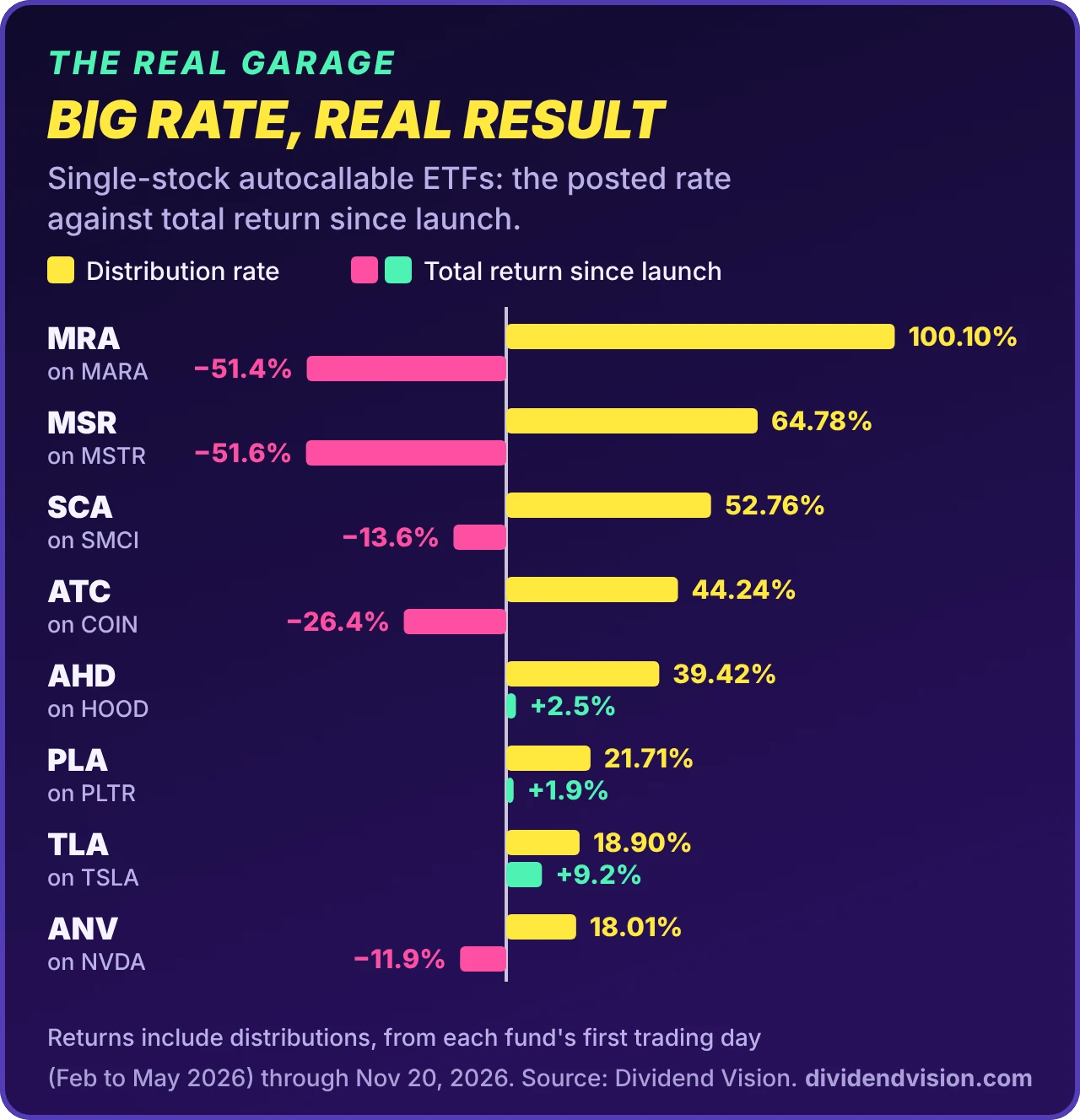
| Fund | Stock | Distribution rate | Fund total return since launch | Stock, same window |
|---|---|---|---|---|
| MRA | MARA | 100.10% | -51.4% | -64.5% |
| MSR | MSTR | 64.78% | -51.6% | -57.8% |
| SCA | SMCI | 52.76% | -13.6% | -43.3% |
| ATC | COIN | 44.24% | -26.4% | -50.9% |
| AHD | HOOD | 39.42% | +2.5% | -16.2% |
| PLA | PLTR | 21.71% | +1.9% | +6.1% |
| TLA | TSLA | 18.90% | +9.2% | -18.0% |
| ANV | NVDA | 18.01% | -11.9% | -30.2% |
Total return includes distributions, from each fund's first trading day (February to May 2026) through November 20, 2026.
Read it both ways, because both are fair.
The cushion is real. Seven of the eight funds did better than the stock they're built on. That is the coupon doing its job in a falling market.
The cushion is not a floor. A fund posting a 100% rate still left its investors down by half, because the stock under it lost almost two-thirds. A rate that high is partly arithmetic: the same payout divided by a share price that keeps shrinking. And in the one case where the stock went up, PLA earned 1.9% while PLTR earned 6.1%. That is the title question, answered: the stockholder got the upside.
Same sell-off, very different rides
Mission 3 isn't hypothetical. In the month through November 20, SPY fell 10.3% and QQQ fell 15.2%. Apart from those two benchmarks, every bar below is an autocallable income ETF that isn't tied to a single stock. Look at the spread.
| DACL | -0.79% |
|---|---|
| ACYS | -2.58% |
| ACYN | -5.02% |
| ACII | -5.08% |
| SPY | -10.3% |
| PAYM | -11.47% |
| CAIE | -11.68% |
| CAIQ | -12.7% |
| QQQ | -15.21% |
| ACYQ | -17.04% |
| VAIE | -21.56% |
| Fund | Distribution rate | One-month total return |
|---|---|---|
| DACL | 7.00% | -0.8% |
| ACYS | 8.22% | -2.6% |
| ACII | 10.41% | -5.1% |
| ACYN | 10.82% | -5.0% |
| PAYM | 11.49% | -11.5% |
| CAIE | 16.43% | -11.7% |
| VAIE | 18.42% | -21.6% |
| CAIQ | 22.00% | -12.7% |
| ACYQ | 26.42% | -17.0% |
Sorted by rate, the losses line up almost in order. The four funds posting under 11% lost between 1% and 5%. The five posting more lost between 11% and 22%, more than SPY in every case. A bigger coupon is generally payment for standing closer to the edge: lines set nearer the starting level, a jumpier index underneath, or both.
Nothing in the fund names tells you that. DACL and VAIE are both autocallable income funds tied to U.S. large caps. One lost under 1% and the other lost more than 21%.
One fund against the index
CAIE has the longest record in the group, so it gets the close-up: $10,000 in CAIE against $10,000 in SPY, distributions reinvested.
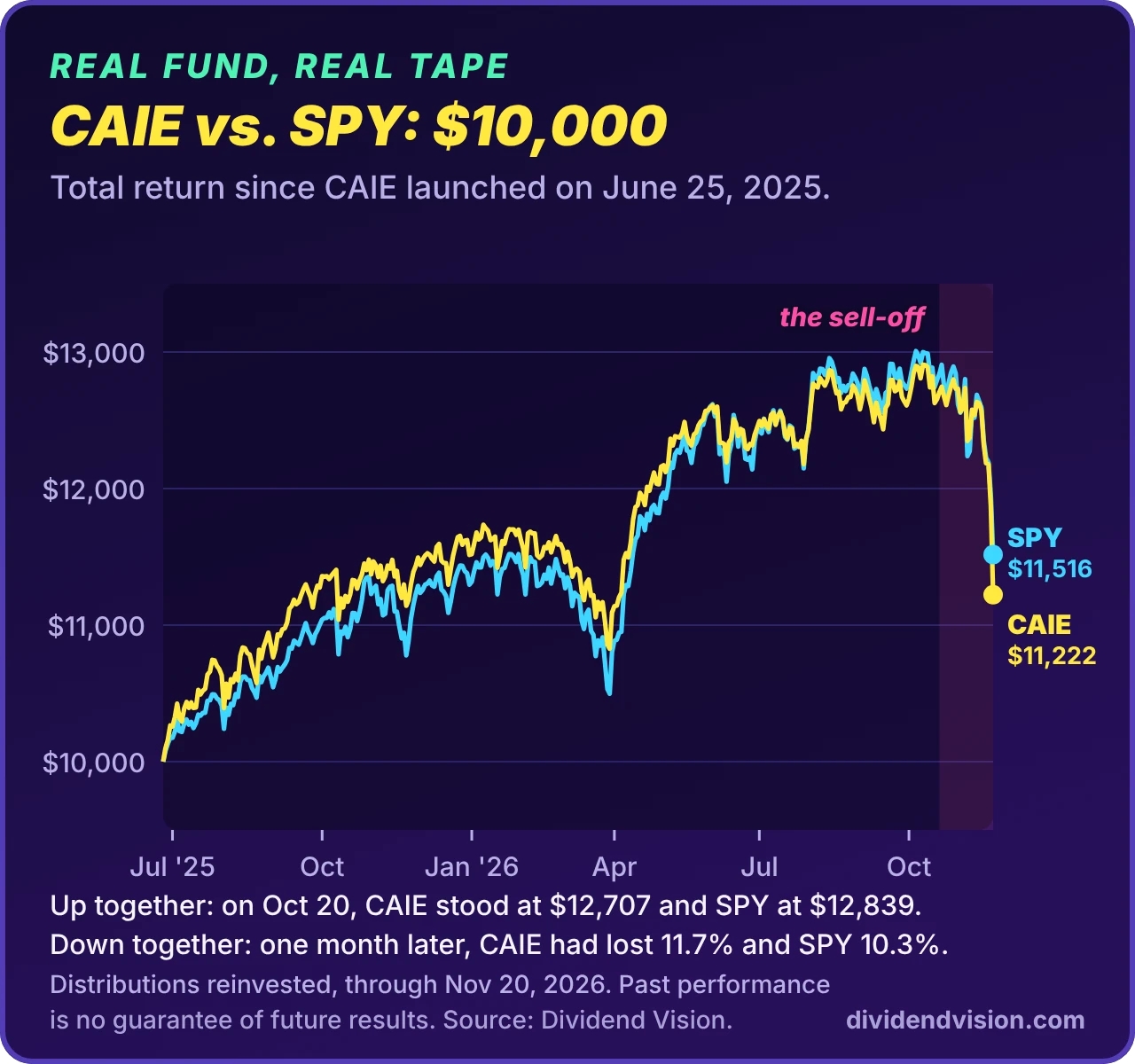
Through October 20 the two were nearly tied, $12,707 for CAIE and $12,839 for SPY. CAIE paid its return out as monthly income along the way. Then the sell-off took 11.7% from CAIE and 10.3% from SPY in a month. Seventeen months in, CAIE is up 12.2% and SPY is up 15.2%.
That is one fund over one stretch, and it is not a verdict on the strategy. It does show what the ladder is and isn't. It is a different way to be paid for taking stock market risk. It isn't a way out of that risk.
Run the comparison yourself
Every number above comes from tools you can open right now, and they'll be fresher than this article by the time you read it.
- Compare the five largest funds side by side: growth of $10,000, the paychecks month by month, and how each one came through the same storms.
- Compare the single-stock funds the same way, or swap in any tickers you like.
- Head-to-head pages for popular pairs: CAIE vs. VAIE, ACYN vs. VAIE and ACII vs. VAIE.
- The screener, filtered to autocallables, to sort all 34 by rate, assets, cost or performance.
- Any ticker page for the distribution history and the price chart. Start with CAIE or ACYN.
One more column worth a look is the Dividend Vision Distribution Safety Score™, which grades how sustainable a payout looks. Most of this group is too new to grade: 16 funds are marked Unproven and 8 have no score yet. Of the ten with a grade, eight are rated Generally safe, led by ACII, ACEI and PAYM at 77, and two, TLA and ANV, are rated Caution at 49. Our guide to the score explains what goes into it.
Where the metaphor breaks
A heist makes a good story. Four parts of it don't carry over.
- You don't control the mission. In the game, skill matters. Here, the outcome is set entirely by where the index sits on fixed dates. You can't drive better.
- There are no save points. When a line breaks, you can't reload.
- One bad day can decide it. In the game, a single job can move a stock overnight. In real life, an earnings report or a central bank meeting can land right on your check date.
- The bank is in the crew. Fees, the options built into the structure, and the credit of the issuer or counterparty all take a cut you never see as a line item. Sweden's financial regulator studied autocalls sold to consumers there from 2018 to mid-2024 and titled its report Poor profitability for consumers from autocalls. Those were bank-issued notes, not U.S. ETFs, but the engine is the same.
Check the dash before you buy
Pull the prospectus and find three numbers: what triggers a call, what earns a coupon, and what happens to principal in a bad market. If you can't explain all three, you're walking into the bank without knowing where the exits are.
Then work down the dash.
- Barrier or buffer? Find out which one the fund's notes use, and whether it applies only at maturity.
- Memory or no memory? Check whether missed coupons can be recovered.
- What does it actually track? An index with volatility controls or a built-in deduction can behave differently from the familiar benchmark in the fund's name.
- Total return, not rate. A payout doesn't tell you what happened to the value of your shares. Compare funds on total return, not on distribution rate alone.
- How did it handle a bad month? You now have one to look at.
Browse the Autocallable fund directory on Dividend Vision to compare strategies. Start with what each fund tracks, then open its prospectus.
The punchline: The coupon pays you for taking a specific deal. Read the deal before you count the money.
Keep exploring
- Autocallable ETFs Explained: the full mechanics, fund by fund
- Return of Capital in Covered-Call ETFs: why a big payout can include your own money
- Why Your Fund's Yield Isn't Telling the Whole Story: distribution rate, SEC yield and total return
- Barclays' autocallable notes brochure, filed with the SEC: an issuer's own walk-through of coupons, calls, barriers and buffers
Illustrative examples only. Not investment advice. The fictional note is not any fund's actual terms. Fund terms differ, performance figures are through November 20, 2026 and will change, past performance does not predict future results, and payouts and principal are not guaranteed.